9 Best AI Coding Assistant Partner Programs Worth Joining
Ask a developer audience to try a coding tool and they will. Ask a search engine where to sign up as a partner, and the trail goes cold fast.
Most AI coding tools promote referral links, enterprise partnerships, or reseller deals instead of public affiliate terms. Commission rates sit behind application forms. Cookie windows go unpublished. Some pay a flat bounty, others pay monthly for a year or longer.
That gap makes the best AI coding assistant partner programs harder to compare than any other software niche.
Technical bloggers, coding YouTubers, and newsletter writers keep hitting the same problem: strong traffic, unclear payouts. What separates a program worth promoting from one that quietly wastes a quarter comes down to details rarely printed on the landing page.
Why Developer Tools Make Strong Affiliate Opportunities
Developer audiences behave differently from consumer traffic. They arrive with a problem already defined, test tools quickly, and buy with their own card or push a purchase request to their lead. That buying pattern explains why AI coding assistant partner programs tend to convert well for technical publishers.
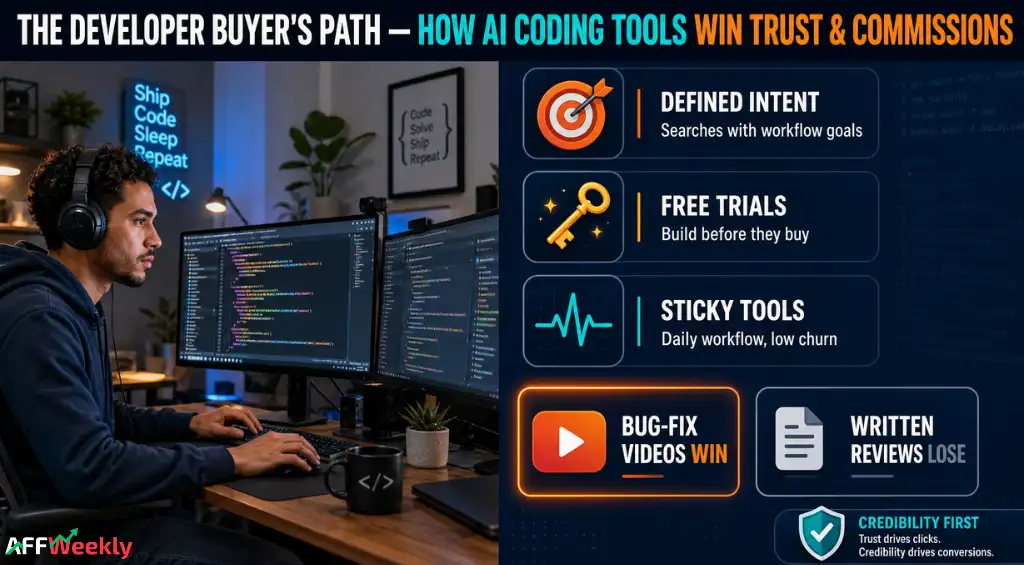
Three factors do most of the work:
Content format matters as much as audience. A recorded bug fix or a side-by-side comparison outperforms a written review, because developers judge tools by output rather than description.
The trade-off is credibility. Technical readers spot promotional writing immediately, and one weak recommendation costs more trust than a missed commission earns.
Payout structures across this niche vary widely, which is where the routes split.
Commission figures sit in the individual tables above. This one maps where each program catches the buyer and how the money actually behaves over time.
9 Best AI Coding Assistant Partner Programs in 2026
| Best AI Coding Assistant Partner Programs | Funnel Stage Targeted | Earnings Curve |
|---|---|---|
| CodeRabbit | Post-code review | Volume dependent |
| BrainGrid | Pre-code planning | Compounds monthly |
| Lovable | Idea to app | Front-loaded spikes |
| Codexirra | Full build workspace | Compounds monthly |
| Replit | Learning and prototyping | Reach over revenue |
| Base44 | Non-technical building | Flat per conversion |
| Tabnine | Enterprise procurement | Deal sized |
| DigitalOcean | Deployment and hosting | Grows with usage |
| Acedit | Developer career stage | Steady twelve months |
1. CodeRabbit Affiliate Program
CodeRabbit sits at the review stage of the development cycle rather than the writing stage. It reads pull requests on GitHub and GitLab, flags logic problems, and leaves line-level suggestions that engineers can accept or argue with, which makes it a complement to Cursor or Copilot instead of a replacement.
That positioning matters for anyone comparing AI coding assistant partner programs. Content about PR hygiene, code quality gates, and DevOps workflows converts better here than a straight tool review, because the buyer is usually an engineering lead solving a review-bottleneck problem.
The affiliate side runs on Dub Partners and pays a fixed amount per qualified lead, so earnings scale with volume of signups rather than with plan size.
| Detail | Data |
|---|---|
| Commission | $30 per lead |
| Program host | Dub Partners |
| Payout model | Fixed CPA |
| Product category | AI code review |
Why choose CodeRabbit: Suits developer newsletters and engineering blogs with team-lead readers. The lead-based payout rewards traffic volume, so high-reach technical content earns faster than niche buyer guides.
2. BrainGrid Creator Program
Among current AI coding assistant partner programs, BrainGrid takes the unusual route of paying on the subscription lifetime rather than the first invoice. The platform handles the planning layer of AI development, turning loose requirements into structured specs before code generation begins.
Its integrations with Cursor, Claude Code, and OpenAI Codex mean creators do not have to talk audiences out of tools they already use. Demos work well because the before-and-after is visible: vague prompt versus scoped ticket.
Brand recognition is thinner than established coding assistants, so the program rewards creators willing to explain the category rather than ride existing search demand for a known name.
| Detail | Data |
|---|---|
| Commission | 15% lifetime recurring |
| Cookie window | 60 days |
| Payout frequency | Monthly |
| Creative assets | Banners, demos, templates |
Why choose BrainGrid: Best for technical bloggers and coding YouTubers building long-term recurring income. Lifetime commission and a 60-day window reward evergreen tutorials over one-off launch coverage.
3. Lovable Affiliate Program
Turning a plain-language prompt into a working full-stack app is Lovable's core function. It generates frontend, backend, authentication, and database layers together, keeps the code editable, and syncs to GitHub, which puts it in the AI app builder bracket rather than the autocomplete bracket.
For affiliates, demonstrability is the advantage. A short screen recording showing an idea reach a live URL outperforms a written feature list, and the free tier removes friction before the paid conversion.
The program runs through Impact and pays a one-time amount on first-time subscribers, so revenue depends on a steady stream of new referrals rather than a compounding base.
| Detail | Data |
|---|---|
| Commission | Up to $100 |
| Affiliate network | Impact |
| Trigger | First-time subscriber |
| Entry barrier | Free plan available |
Why choose Lovable: Strong pick for video creators and startup-focused publishers. Payouts are one-time, but the demo-friendly product and large search demand make conversion volume realistic.
4. Codexirra Affiliate Program
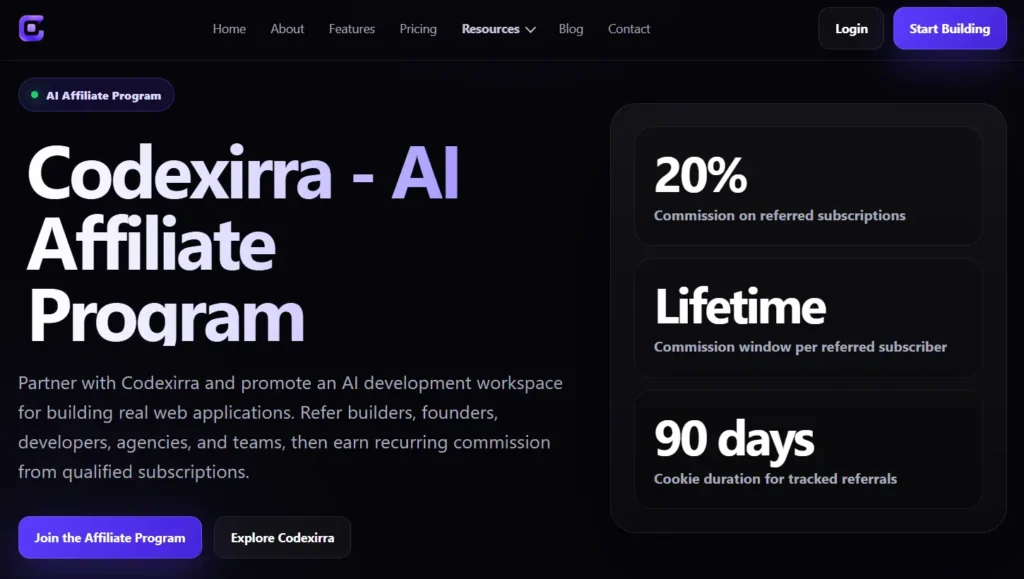
Codexirra offers a connected workspace where an app is generated, visually edited, previewed live, debugged through runtime logs, snapshotted, and published, all without leaving the environment. Database browsing, custom domains, and GitHub publishing round out the workflow.
Its affiliate terms are among the more generous in this niche: lifetime revenue share on referred subscriptions plus one of the longest attribution windows available across AI coding assistant partner programs. That combination suits comparison articles, where readers often return weeks later.
Applications go through Reditus. The intended audience spans founders, agencies, students, and operators, so build-in-public content and course material both fit the referral model.
| Detail | Data |
|---|---|
| Commission | 20% lifetime |
| Cookie window | 90 days |
| Platform | Reditus |
| Audience fit | Founders, agencies, students |
Why choose Codexirra: Well suited to comparison writers and course creators. Lifetime revenue share plus a 90-day window gives slower-converting educational content a real chance to earn.
5. Replit Creator Program
Replit Agent builds applications from a prompt, fixes its own bugs, explains changes, and deploys, all inside a browser IDE. Because hosting and development share one environment, a tutorial can go from blank project to live link without any local setup.
The Creator Program is structured as a partnership track rather than a payout table. Accepted creators get collaboration opportunities, early access to features, and promotional support from the brand.
Anyone benchmarking AI coding assistant partner programs purely on commission percentage will find this one harder to model, since the value arrives as reach and exposure rather than a fixed rate card.
| Detail | Data |
|---|---|
| Program type | Creator partnership |
| Referral reward | $20 credits, both |
| Core benefits | Early access, promotion |
| Content fit | Tutorials, build-in-public |
Why choose Replit: Fits creators who value distribution over commission. Brand recognition and browser-based demos make it ideal for educators publishing consistent app-building content.
6. Base44 Affiliate Program
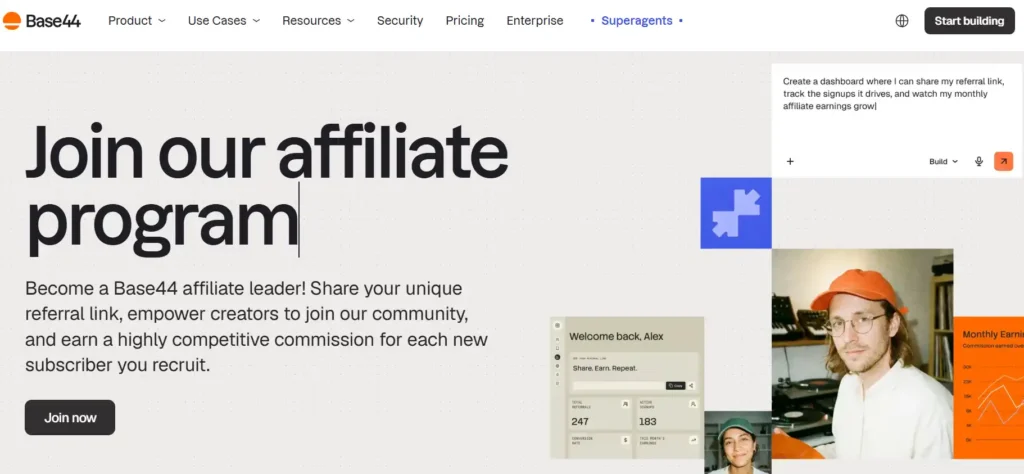
Base44 belongs to the no-code AI app builder wave, letting non-technical founders and business teams ship functional applications without touching a stack. That widens the promotable audience well beyond professional engineers.
The commission structure is deliberately simple. A flat amount is paid per referral that converts to a paid plan inside the qualifying period after lock-in, which makes forecasting straightforward: conversions multiplied by a known figure, with no plan-tier variables to model.
Approved partners receive banners, email templates, product images, and product documentation through the affiliate dashboard. Program questions go to the dedicated affiliates address listed on the official page.
| Detail | Data |
|---|---|
| Commission | $100 fixed |
| Cookie window | 30 days |
| Qualifying action | Paid subscription |
| Partner assets | Banners, emails, images |
Why choose Base44: Good match for creators reaching non-technical builders. Flat payouts make earnings easy to forecast, though the one-time model builds no recurring base.
7. Tabnine Partner Program
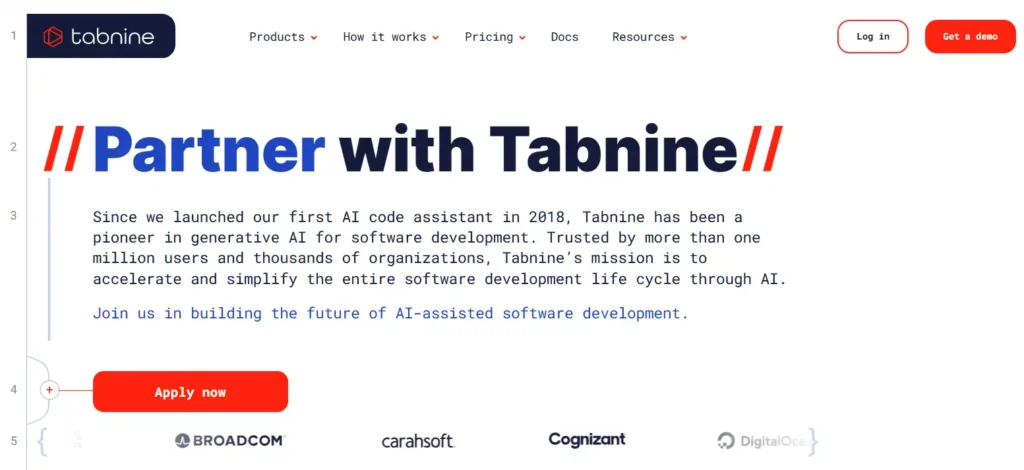
Privacy posture is Tabnine's defining trait. The assistant runs locally, behind a firewall, or in the cloud, holds a zero data retention policy, and trains public models only on permissively licensed open source, which is why regulated industries shortlist it.
Its partner network is organised into channels rather than a single affiliate link: cloud partners, technology partners, and consulting firms deploying AI-assisted development inside enterprises. DigitalOcean's integration, offering Tabnine Pro for teams of one to ten seats, shows how the cloud channel works in practice.
Entry runs through an application form, making this a B2B route for agencies and consultancies rather than a self-serve option for publishers.
| Detail | Data |
|---|---|
| Program type | Channel partnership |
| Partner tracks | Cloud, technology, consulting |
| Entry method | Application form |
| Deployment options | Local, on-prem, cloud |
Why choose Tabnine: Aimed at consultancies and integrators serving regulated enterprises. Compliance credentials open doors that consumer-grade coding assistants cannot, though publishers gain little here.
8. DigitalOcean Affiliate Program
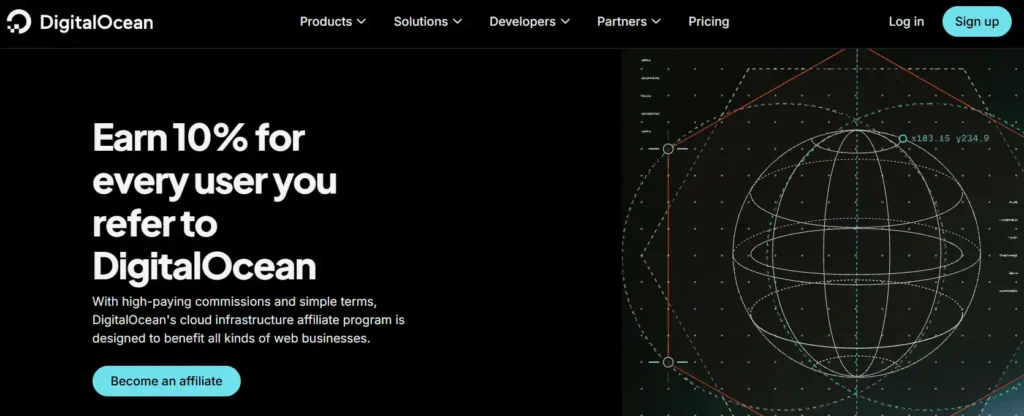
DigitalOcean covers what happens after the code is written. Droplets, managed databases, Kubernetes, App Platform, and GPU instances for AI workloads give creators a natural next step at the end of any build tutorial.
The payout is tied to referred customer spend across the first year rather than to a single subscription price. As a referral scales infrastructure, commission scales with it, which is a different earnings shape from the flat and recurring models found elsewhere in AI coding assistant partner programs.
It is not a coding assistant, so treat it as a companion recommendation inside deployment content rather than a headline pick.
| Detail | Data |
|---|---|
| Commission | 10% customer spend |
| Duration | First 12 months |
| Cookie window | 30 days |
| Content fit | Deployment, DevOps tutorials |
Why choose DigitalOcean: Ideal for cloud and DevOps educators. Usage-based commission grows alongside referral infrastructure, rewarding audiences that actually ship and scale production projects.
9. Acedit Affiliate Program
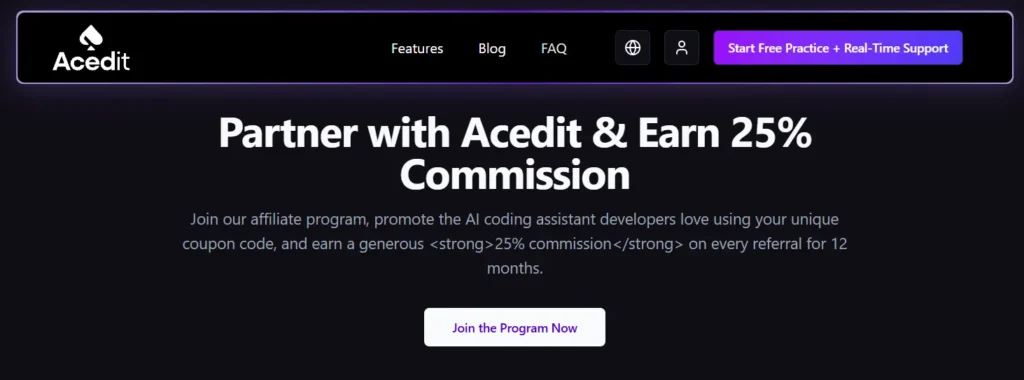
Acedit targets the developer career moment rather than the development workflow. Delivered as a Chrome extension, it runs mock interviews, suggests answers in real time during calls on Zoom, Google Meet, and Microsoft Teams, pulls context from LinkedIn, and drafts cover letters.
Attribution here is coupon-based rather than cookie-based, which sidesteps browser tracking loss entirely. Commission applies to qualifying purchases made with the partner's code across the first year of the customer relationship.
Payouts arrive monthly through PayPal once a minimum balance is reached, so smaller publishers may hold earnings for a cycle or two before the first transfer clears.
| Detail | Data |
|---|---|
| Commission | 25%, 12 months |
| Tracking method | Unique coupon code |
| Payout | Monthly, PayPal |
| Minimum threshold | $100 balance |
Why choose Acedit: Best for career coaches and interview-prep channels. Coupon tracking survives cookie blocking, making it dependable for social and video traffic that cookies routinely miss.
Recurring vs Fixed CPA in AI Coding Assistant Partner Programs
Payout structure decides how your earnings behave over time. Fixed CPA pays a set amount once. Recurring commission pays a percentage for as long as the referral keeps paying. Both appear across AI coding assistant partner programs, and neither is automatically better.
Fixed CPA suits high-volume traffic. CodeRabbit pays $30 per qualified lead. Lovable pays up to $100 per first-time subscriber. The money lands fast, and you know what a conversion is worth before you publish.
Recurring suits smaller, loyal audiences. BrainGrid pays 15% lifetime on referred customers. Blackbox AI pays 15% for up to 12 months. Earnings start slow, then compound as referrals stack.
Two things change the maths:
Run the numbers against your actual traffic, then decide which formats deserve the effort.
What Content Actually Converts Developer Audiences?
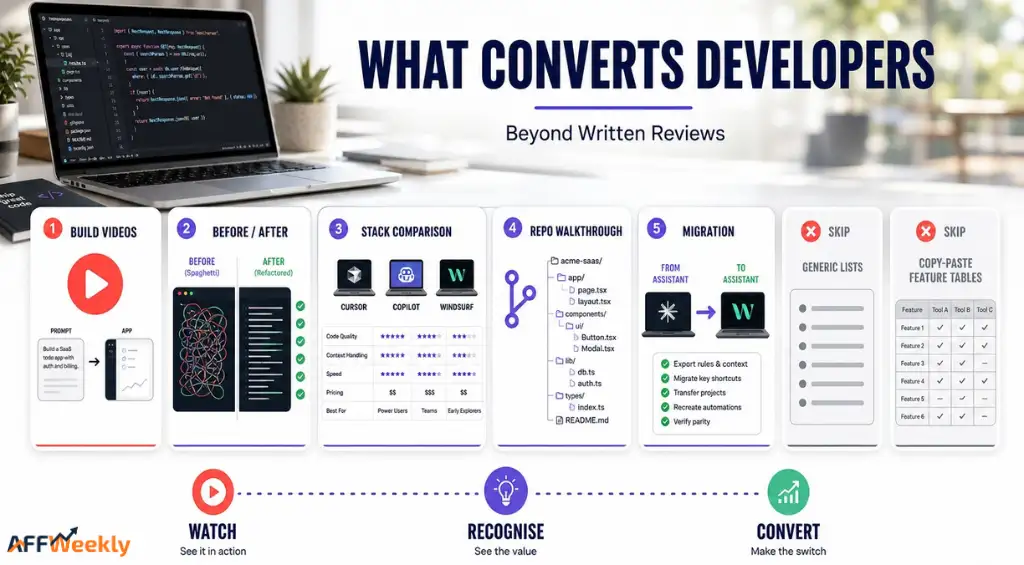
Developers rarely convert from written reviews. They convert after watching a tool solve a problem they recognise. Format choice matters more here than in most affiliate niches.
The formats that perform:
Two formats to skip: generic listicles without demos, and feature roundups copied from pricing pages. Both rank badly and convert worse.
One practical note. Video and repo content carries links poorly, so pair each piece with a written companion page that holds your tracked links and disclosure.
Format only pays off once the payout actually reaches your account.
Final Take
Commission rates get most of the attention, but attribution windows and payout mechanics decide what actually lands in an account. A lifetime revenue share on a tool your readers ignore earns less than a flat payout on something they already trust.
Start with two or three programs that match what you publish, watch how they convert over a quarter, then expand. Terms across AI coding assistant partner programs shift quietly, so check partner pages before you cite figures.
The programs reward patience more than volume, and that tends to show up around month six.