7 Best Legal Service Affiliate Programs: Real Payouts

Legal offers look easy on paper. A visitor needs an LLC, a will, or a trademark filing, clicks through, and the commission should follow. Then the report shows a $0 payout because the sale landed outside a 30-day window, or the network paid per lead while the merchant paid per funded order.
Commission pages rarely explain any of that. Two programs can advertise the same rate and settle very differently once refunds and clawbacks hit.
AFFWeekly spent time inside these dashboards instead of trusting the sales copy. Affiliates promoting business tools, LLC guides, or legal content will notice the difference fast. The top legal service affiliate programs below are sorted by what actually clears.
Top 7 Legal Service Affiliate Programs (Ranked by Cleared Earnings)
| Best Legal Service Affiliate Programs | Payout Structure | Earning Pattern |
|---|---|---|
| LegalZoom | Flat CPA | Single payout |
| LawDepot | Percentage with split | Single payout |
| Wolters Kluwer | Flat percentage | Single payout |
| Plug and Law | Percentage per product | Single payout |
| Termly | Recurring revenue share | Compounds across renewals |
| ZenBusiness | Tiered flat CPA | Scales by package |
| Bizee | Itemised flat CPA | Repeats per service |
How AFFWeekly Tested These Legal Service Affiliate Programs
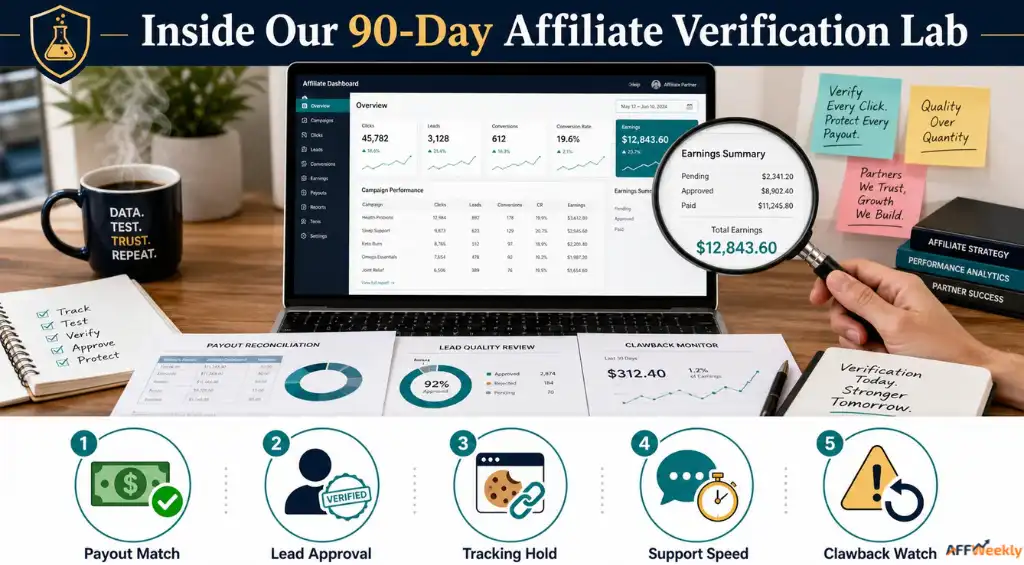
Affiliate dashboards and sales pages tell two different stories. AFFWeekly signed up for each legal service affiliate program on this list, tracked live campaigns, and compared what was advertised against what actually cleared into the payment account.
The testing ran across a 90-day window. Here is what we measured:
Programs that showed a gap between their advertised rate and the cleared amount were flagged. A few were removed from the list entirely after payouts stalled beyond 60 days with zero explanation from the affiliate team.
The section below breaks down the commission models behind each program, so the numbers make sense before the individual reviews start.
1. LegalZoom Affiliate Program
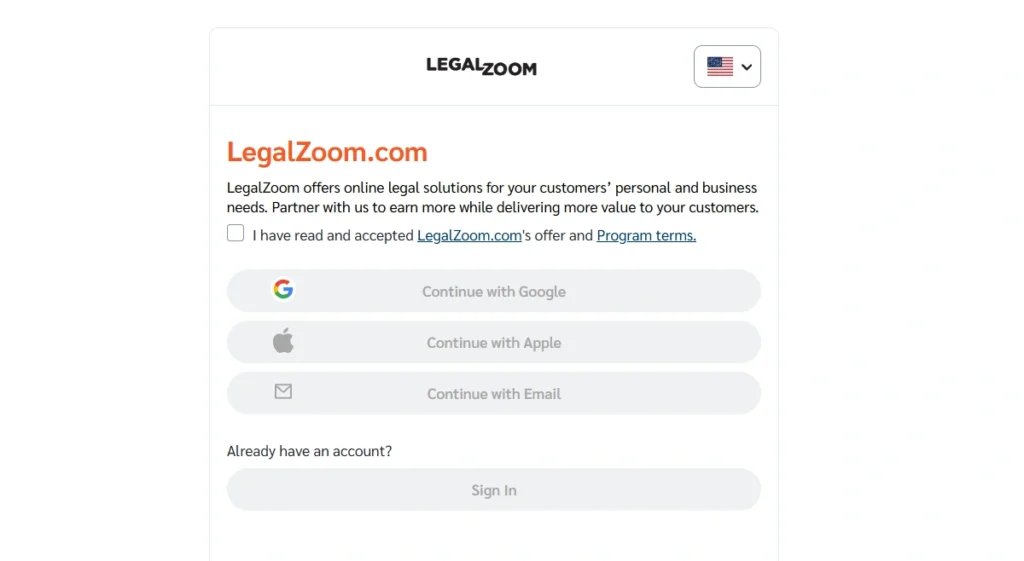
LegalZoom sits at the top of most legal service affiliate programs lists for one reason: brand recognition does half the selling. Founded in 2001, the platform covers LLC formation, trademark registration, estate planning documents, and attorney consultations across all 50 states.
The partner program runs through CJ Affiliate. Business formation products carry the strongest payouts, with content partners earning up to $125 per acquisition on formation packages. Standard commission on other services sits at 15%.
Traffic quality matters here more than volume. LegalZoom explicitly blocks coupon sites, paid ad traffic, and discount directories from earning commission, so affiliates leaning on editorial content and organic search see the cleanest approval rates.
| Parameter | Value | Parameter | Value |
|---|---|---|---|
| Cookie window | 30 days | Direct linking | Not permitted |
| Account fee | None | Dormancy rule | 180 days inactive |
| Payout scaling | Volume based tiers | Commission reversals | Returns and cancellations |
| Duplicate orders | Reversed | Disputed orders | May be refused |
Why Choose LegalZoom: Best for business blogs and startup content sites with US traffic. The brand converts without heavy persuasion, and formation packages carry the highest per-sale value in this category.
2. LawDepot Affiliate Program
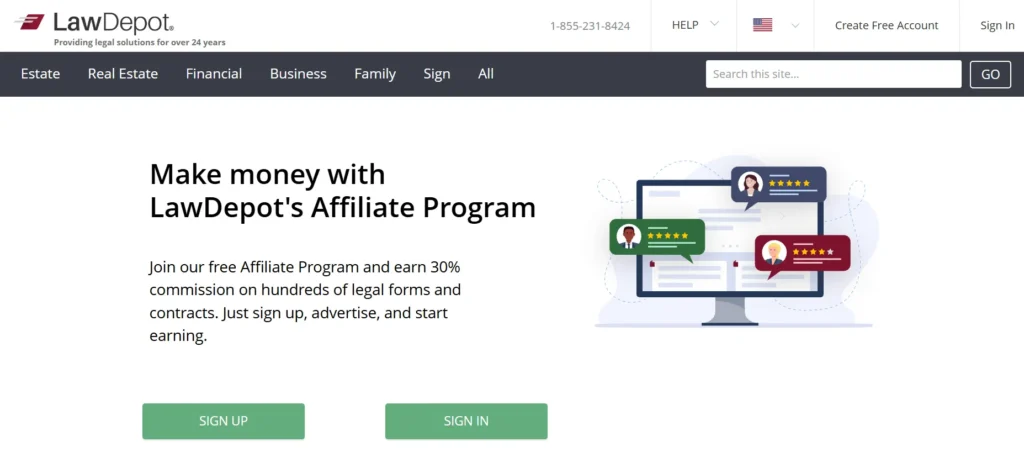
Cookie duration is where LawDepot separates itself from every competitor in the legal document space. The program runs a full 365-day tracking window, which is twelve times the industry standard for legal service affiliate programs.
Operating since 2001, LawDepot publishes over 150 customizable legal templates covering estate planning, real estate agreements, business contracts, and lending documents. Document prices sit in an accessible range, which keeps conversion friction low.
The commission structure includes a flexible split that few programs offer. Affiliates can take the full 30% as commission, or convert part of it into a customer discount. A 20% commission paired with a 10% reader discount is a common configuration for content sites building trust with cost-conscious audiences.
| Parameter | Value | Parameter | Value |
|---|---|---|---|
| Payment calculated | First business day | Payment sent | Within five days |
| Minimum threshold | $50 balance | Below threshold | Carries forward monthly |
| Payment methods | PayPal or mail | Membership fee | None |
| Creative assets | HTML and URL | Asset access | Instant after signup |
Why Choose LawDepot: Ideal for affiliates publishing evergreen legal template content. The 365-day cookie captures buyers who bookmark, compare, and return weeks later.
3. Wolters Kluwer Affiliate Program
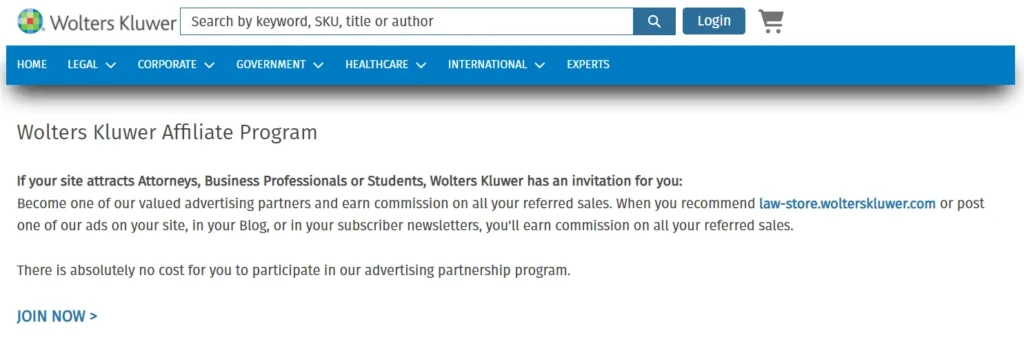
Unlike consumer-facing legal service affiliate programs, Wolters Kluwer targets practicing professionals. The company supplies research products, compliance software, and legal education materials to law firms, corporate counsel teams, and government agencies.
Commission sits at 10%, which reads low against the 30% rates elsewhere on this list. The average order value corrects that impression. Wolters Kluwer reports an average sale near $400, putting typical affiliate earnings around $40 per referred purchase.
Subject coverage spans antitrust, banking and finance, intellectual property, labor and employment, family law, and taxation. Sites serving attorneys, paralegals, and law students convert better here than general small business blogs.
| Parameter | Value | Parameter | Value |
|---|---|---|---|
| Network | CJ Affiliate | Cookie window | 30 days |
| Participation cost | Free | Rate consistency | All products |
| Approved channels | Website and blog | Also permitted | Subscriber newsletters |
| Product formats | Software and research | Add-on formats | Training resources |
Why Choose Wolters Kluwer: Suited to legal industry publications and professional education sites. High order values offset the modest percentage, especially with reader bases of practicing attorneys.
4. Plug and Law Affiliate Program
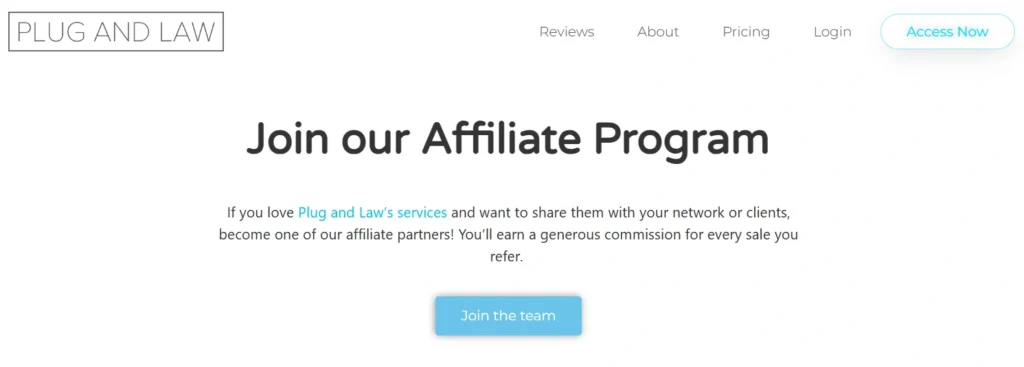
Founded by attorney Erika Kullberg, Plug and Law targets a specific gap: online business owners who need website policies, client agreements, and compliance documents without attorney fees. The Legal Bundle is the flagship product at $97.
Affiliate payouts sit at 30% on Plug and Law products. A separate 10% rate applies to Kullberg's Mastering YouTube course, which sits outside the core legal catalog.
Tracking runs through ThriveCart with a 30-day attribution window. Payments process via PayPal on a 60-day cycle, and that delay is intentional. The company holds commissions until the 30-day money-back guarantee period on the Legal Bundle expires, which reduces clawbacks but slows cash flow.
| Parameter | Value | Parameter | Value |
|---|---|---|---|
| Attribution basis | Same session required | Link destination | Product page only |
| Age requirement | 18 or older | Bot accounts | Not permitted |
| Untracked clicks | No commission | Mistyped codes | No liability |
| Terms violation | Commission forfeiture | Terms updates | Without prior notice |
Why Choose Plug and Law: Strong fit for creator economy and online business audiences. The $97 bundle price point converts well with freelancers and solopreneurs needing website policies.
5. Termly Affiliate Program
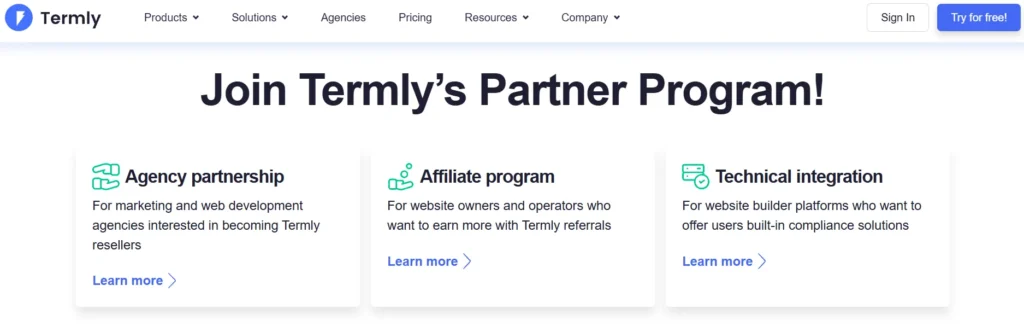
Privacy compliance is the angle Termly owns, and it is a category with genuine recurring demand. The platform generates privacy policies, terms of service documents, and cookie consent managers built around GDPR, CCPA, ePrivacy Directive, and LGPD requirements.
The affiliate program pays 35% revenue share, and that percentage applies to both initial subscriptions and renewals. Combined with the 180-day cookie window, Termly offers one of the longest attribution periods among legal service affiliate programs.
Tracking runs on Impact. The program positions itself toward professional advisors and ad network operators rather than general publishers, though content affiliates in the web development and SaaS space convert well given the recurring compliance need every website owner faces.
| Parameter | Value | Parameter | Value |
|---|---|---|---|
| Minimum payment | $50 | Payment frequency | Monthly |
| Payment methods | Wire or PayPal | Geo targeting | Worldwide |
| Permitted traffic | Content and email | Also permitted | Display and loyalty |
| Prohibited traffic | PPC bidding | Also prohibited | Brand misspelling |
Why Choose Termly: Best for web development, SaaS, and blogging audiences. Every site owner needs privacy compliance, and the 35% recurring rate compounds across renewals.
6. ZenBusiness Affiliate Program

Tiered payouts by package level make ZenBusiness one of the more transparent legal service affiliate programs to model earnings against. The company handles LLC and corporation formation, registered agent service, EIN filing, and ongoing state compliance through a single dashboard.
Base commissions scale with the package the referred customer buys: $75 for Starter, $125 for Pro, and $175 for Premium. Higher payout tiers unlock as conversion volume increases, negotiated through the affiliate team.
The program migrated to Awin, which supplies real-time click and conversion reporting. ZenBusiness maintains an in-house affiliate support team available for calls rather than routing partners through a generic network helpdesk.
| Parameter | Value | Parameter | Value |
|---|---|---|---|
| Cookie window | 30 days | Qualifying action | New business formed |
| Excluded partners | Coupon sites | PPC restriction | No TM bidding |
| Creative library | Ready-made assets | Partner education | Included resources |
| Target market | United States | Audience type | Entrepreneurs and owners |
Why Choose ZenBusiness: Best for entrepreneurship and startup content with US audiences. Package-tiered payouts reward affiliates whose readers buy beyond the entry-level formation product.
7. Bizee Affiliate Program

Formerly Incfile, Bizee has powered business formations since 2004 with over 200,000 entities formed. The pitch to referred customers is straightforward: $0 LLC formation plus state fees, with the first year of registered agent service included.
The commission table is unusually granular. Beyond formation packages, Bizee pays separately for registered agent referrals, trademark filings, annual reports, EIN applications, foreign qualifications, amendments, and dissolutions, letting affiliates monetize the full compliance lifecycle rather than the initial formation alone.
One clause deserves attention before joining. Bizee reserves the right to pay $0 on Basic package orders when an affiliate recommends only Basic tier purchases without add-ons, which makes the headline maximum payout misleading for affiliates driving purely entry-level traffic.
| Parameter | Value | Parameter | Value |
|---|---|---|---|
| Network | Awin | Cookie window | 30 days |
| PPC bidding | Strictly prohibited | Google Shopping | Not allowed |
| Coupon sites | Banned | Browser extensions | Banned |
| Branded pages | Not permitted | Traffic ratio | Non-branded must lead |
| Content approval | Required pre-publication | Affiliate contact | affiliates@incfile.com |
Why Choose Bizee: Best for affiliates covering the full business compliance cycle. The itemized payout table monetizes trademark, EIN, and registered agent referrals beyond the initial formation.
Why Cookie Length Matters More in Legal Offers
Legal purchases move slowly. Someone researching an LLC formation or a trademark filing rarely converts on the first visit. They compare providers, read pricing pages, and circle back days or weeks later. If the affiliate cookie expires before that return visit, the commission disappears.
A 30-day cookie sounds reasonable until it runs against real legal buyer behavior:
Programs with 30-day windows lose a measurable share of conversions in this niche. A 90-day or 365-day cookie captures the same traffic without giving up late-stage buyers who already clicked through weeks earlier.
The gap between a short cookie and a long one translates directly into cleared revenue. AFFWeekly weighted cookie duration heavily when ranking the legal service affiliate programs on this list, and the next section explains what compliance rules apply before promoting any of them.
The Compliance Rules Legal Affiliates Cannot Ignore
Promoting legal service affiliate programs carries compliance risks that other niches do not. Two areas matter here: FTC disclosure and unauthorized practice of law (UPL). Getting either one wrong can end an affiliate account or trigger a state bar complaint.
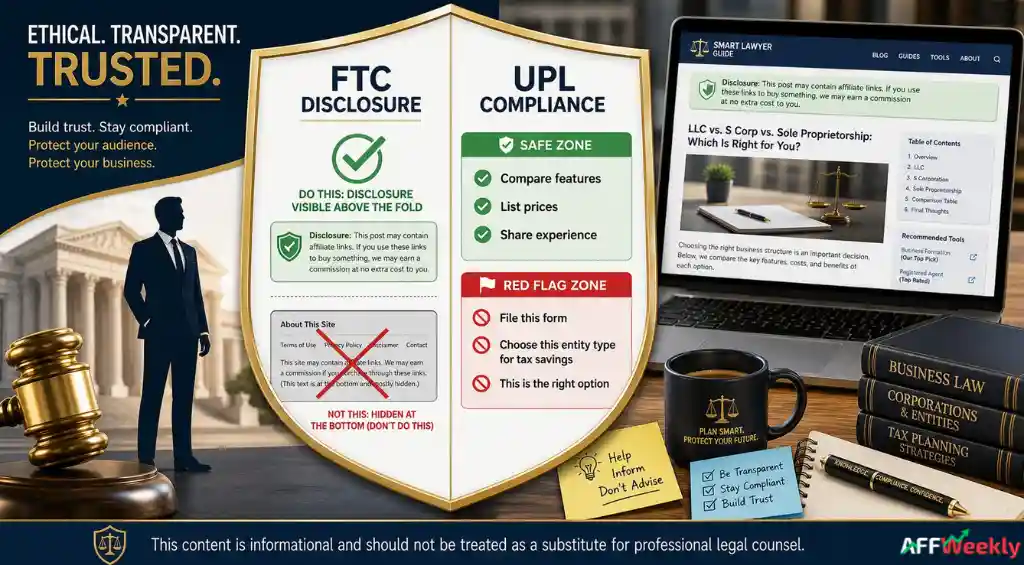
FTC disclosure is straightforward but strict. Affiliate links must be labeled clearly, above the fold, before the reader clicks anything. A buried disclaimer at the bottom of a 3,000-word article does nothing. The FTC treats that as a violation regardless of intent.
Here is where legal affiliates face a second, less obvious risk:
AFFWeekly recommends adding a one-line disclaimer to any post that promotes legal tools: “This content is informational and should be treated as a substitute for professional legal counsel.” That single line reduces exposure significantly.
Final Payout Reality Check
The gap between an advertised rate and a cleared payment is where this niche gets decided. Cookie length, lead acceptance, and clawback policy shape earnings more than the headline percentage ever will.
Legal service affiliate programs reward patience. Buyers research slowly, compare providers, and return weeks later, so attribution windows carry real weight in this category.
Terms shift without warning. AFFWeekly rechecks these programs regularly, though confirming current details directly with an affiliate manager remains sensible before building content around any of them.
Start with one program, track what actually settles, then expand.