
Top 8 CRM Affiliate Programs Worth Promoting in 2026
Signing up for a CRM affiliate program takes five minutes. Earning from one takes a lot longer. The links go out, the clicks come in, and the dashboard stays flat.
Part of the problem is that no two programs pay alike. One offers 20% on a single sale. Another pays 40% every month for as long as the customer stays subscribed. Approval rules differ too, and some brands quietly reject small publishers.
Sorting that out means reading past the marketing page. The top CRM affiliate programs covered here were compared on commission structure, cookie length, payout terms, and how realistic approval is for a newer affiliate. Beginners and seasoned SaaS marketers tend to land in different places.
How CRM Affiliate Programs Actually Pay: 12 Months vs Lifetime
Commission length matters more than headline rate in the CRM niche. Two payout models dominate: fixed-term recurring and lifetime recurring.
Fixed-term programs pay a share of the subscription for a set period, usually 12 months. HubSpot pays 30% recurring for up to a year. Pipedrive and Close both pay 20% across the first 12 months of a referred subscription.
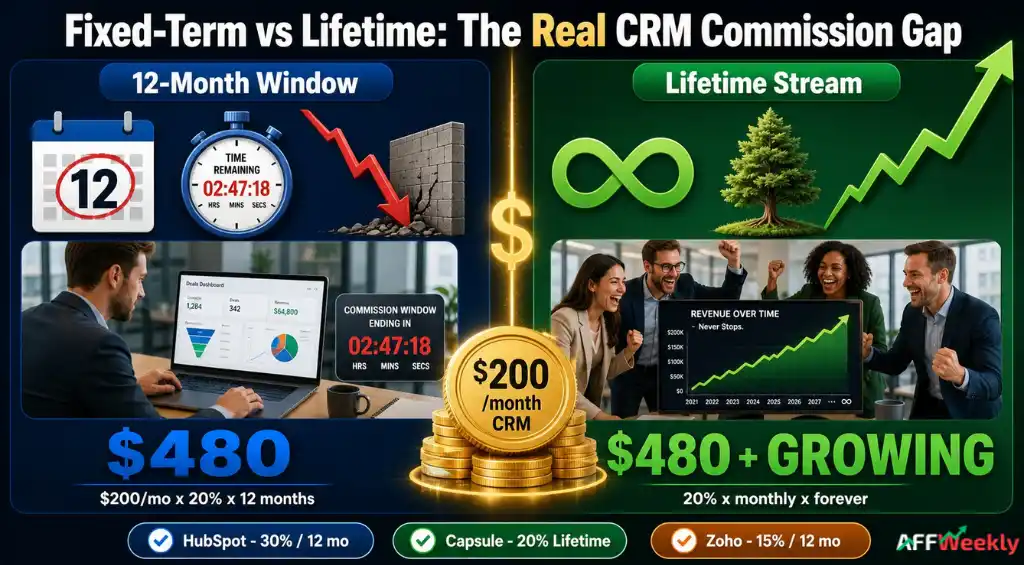
Zoho CRM pays 15% over the same window. Once the term closes, payments stop while the customer keeps paying the vendor.
Lifetime programs keep paying as long as the account stays active. Capsule pays 20% for the life of each referred account, a structure that suits low-churn small business tools.
Quick comparison:
The math shows the gap. A $200 per month CRM account at 20% returns roughly $480 across twelve months on a fixed-term deal. The same account under lifetime terms keeps paying into year two and beyond.
Payout length counts only when tracking survives long enough to record the sale, which puts cookie windows next in line.
Top 8 CRM Affiliate Programs, Tested and Ranked
| Best CRM Affiliate Programs | Ideal Referral Audience | Biggest Payout Blocker |
|---|---|---|
| HubSpot | Enterprise marketing teams | Free tier drift |
| Monday.com | Cross-team workflow users | Variable partner terms |
| Pipedrive | Outbound SMB sellers | Two-month lock delay |
| Close | Call-heavy startups | Narrow buyer pool |
| GoHighLevel | Marketing agency owners | Strict compliance rules |
| Zoho | Cost-conscious global SMBs | Data centre mismatch |
| ActiveCampaign | Email-first small businesses | Two-referral payout gate |
| Capsule | Freelancers, micro teams | Short attribution window |
1. HubSpot Affiliate Program
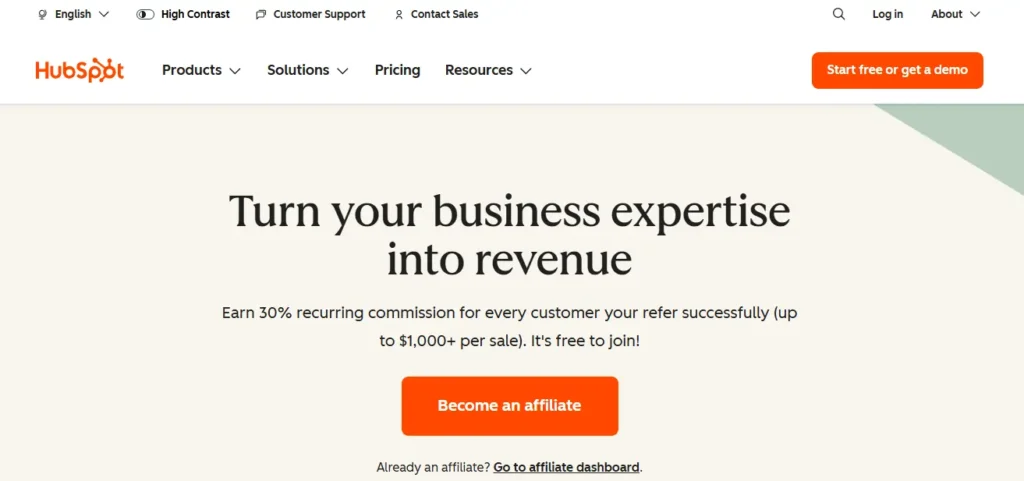
HubSpot anchors most CRM affiliate programs lists for one reason: plan value. The platform pairs a free CRM with paid Marketing, Sales, Service and Content hubs, so a single referral can convert on any product line, and enterprise contracts carry payouts that dwarf typical SaaS commissions.
Applications usually get a decision within two to three business days, with approval favouring publishers who run an established site and a business audience.
Content that converts here skews comparative and technical: HubSpot against Salesforce, hub-by-hub pricing breakdowns, onboarding walkthroughs for sales teams.
The freemium tier is the trade-off. Plenty of referred users settle into the free CRM and never trigger a payable event, so pages aimed at buyers already comparing paid plans carry the revenue.
| Detail | Information |
|---|---|
| Commission | 30% recurring |
| Duration | Up to 12 months |
| Cookie window | 180 days |
| Network | Impact |
| Payouts | Monthly, EFT or PayPal |
| Minimum payout | $10 |
Why it stands out: Suited to B2B publishers with buyer-stage traffic. The long cookie absorbs enterprise sales cycles, and high plan prices lift single-referral value well past niche SaaS averages.
2. Monday.com Affiliate Program
Monday.com sells a Work OS rather than a pure sales tool, with monday CRM sitting alongside project, marketing and dev boards. That breadth matters for affiliates, because the same referral link serves audiences that would never search for CRM software directly.
Terms are set by partner group inside the dashboard, so two affiliates promoting the identical product can operate on different structures. Public listings quote different tracks, one revenue-share based and one combining a smaller share with a per-lead component. Reading the exact terms after approval is a first step rather than an afterthought.
Among CRM affiliate programs, this one rewards visual formats. Board walkthroughs and template demos outperform written reviews.
| Detail | Information |
|---|---|
| Commission | Up to 25% |
| Alternative track | 100% of first year |
| Cookie window | 90 days, reset per click |
| Platform | PartnerStack |
| Payouts | PayPal or Stripe |
| Approval time | A few days |
Why it stands out: Best for creators with mixed business audiences. Broad product appeal widens the referral pool, though the generous free plan can delay a first paid conversion.
3. Pipedrive Affiliate Program
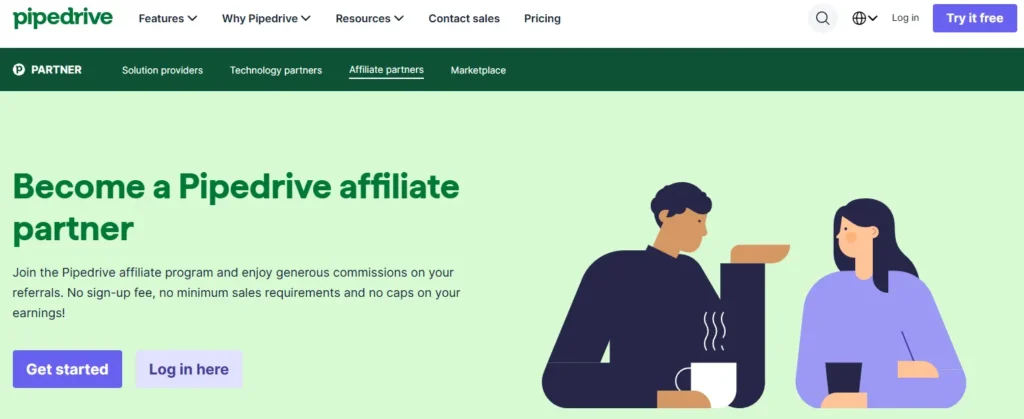
Pipedrive built its reputation on visual pipeline management for small sales teams, and its affiliate terms sit among the most transparent in the CRM category. Locking dates, tier thresholds and payment days are published rather than hidden behind approval.
Progression is tiered. Entry partners start on a base revenue share, consistent performers move up a band, and top affiliates negotiate custom arrangements. Add-on purchases inside the commission period count toward the same revenue share.
Cash timing deserves attention before scaling spend on any of these CRM affiliate programs. A sale locks two months after the transaction, so revenue lands well behind the click that produced it.
| Detail | Information |
|---|---|
| Commission | 20% or 30% by tier |
| Duration | First 12 months |
| Cookie window | 90 days |
| Platform | PartnerStack |
| Payout day | 13th monthly |
| Minimum withdrawal | $5 |
Why it stands out: A strong fit for SMB and sales-process bloggers. Published locking rules, a low threshold and hourly reporting make earnings predictable rather than guesswork.
4. Close Affiliate Program
Close targets small teams that live in the phone and inbox, packing power dialling, predictive dialling, email sequencing and lead scoring into a single sales CRM. Its buyer is a founder or rep chasing call volume, not a marketing suite.
That focus narrows the audience and sharpens conversion. Readers comparing dialler software or outbound stacks arrive with intent already formed, so mid-funnel pages tend to outperform broad category posts.
Affiliates get a self-serve dashboard for commission tracking plus a dedicated support team, which puts it ahead of the CRM affiliate programs that leave partners guessing at attribution.
| Detail | Information |
|---|---|
| Commission | 20% recurring |
| Duration | 12 months |
| Conversion window | 90 days |
| Platform | PartnerStack |
| Dashboard | Self-serve tracking |
| Support | Dedicated affiliate team |
Why it stands out: Made for consultants, sales coaches and outbound content sites. Narrow positioning means fewer clicks but higher relevance from readers already comparing dialler-first CRMs.
5. GoHighLevel Affiliate Program
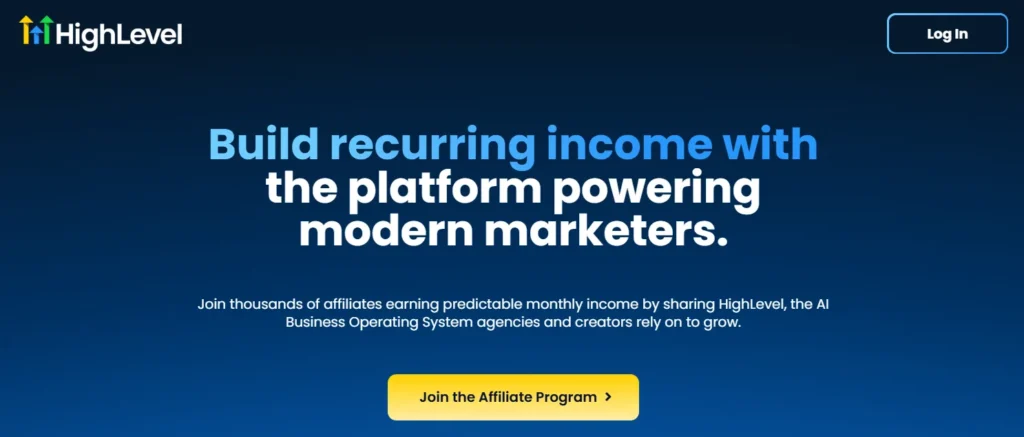
GoHighLevel serves agencies rather than end businesses, bundling CRM, funnels, automation, booking and white-label SaaS resale into one subscription. Agencies wire client operations through it, which pushes retention far above typical SaaS churn.
Payout structure separates it from the rest of this list. Earnings continue for as long as the referral stays subscribed, and a second layer pays on affiliates recruited into the program, so income compounds from two directions.
Lifetime terms reward long-form assets. Setup tutorials, SaaS-mode guides and agency case studies keep earning after publication, which few CRM affiliate programs support this well. Compliance rules on promotion are strict, so claims in ads and thumbnails need care.
| Detail | Information |
|---|---|
| Commission | 40% recurring |
| Duration | While subscription stays active |
| Second tier | 5% on sub-affiliates |
| Plans referred | $97, $297, $497 |
| Payouts | Monthly, PayPal or deposit |
| Trial offered | 30 days extended |
Why it stands out: Built for agency owners and marketing YouTubers. Uncapped lifetime commissions and low churn compound over years, offset by tight rules on how the platform is promoted.
6. Zoho Affiliate Program
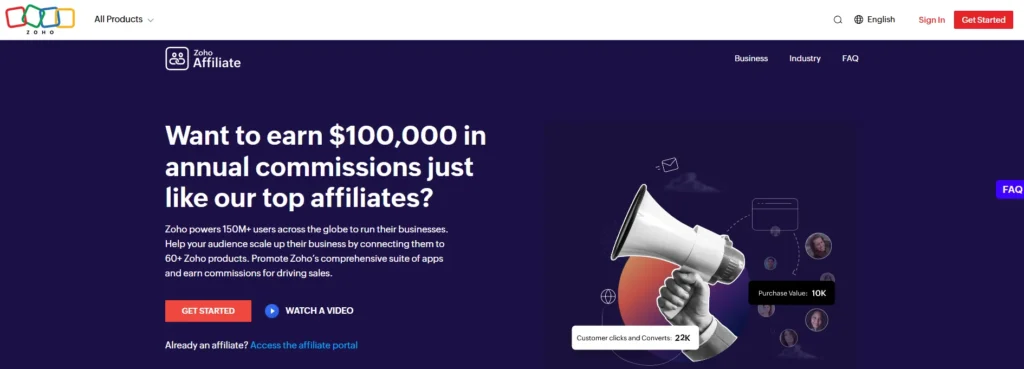
Zoho approaches affiliates differently to single-product vendors. One account covers the full application suite, including Zoho CRM, Books, Projects and Zoho One, so business-audience publishers can monetise finance, HR and helpdesk content from the same login.
The rules carry more conditions than most. Commission applies only to a customer's first paid purchase, never to later subscriptions of other Zoho services. Referrals must also sign up in the same data centre where the affiliate registered, which effectively splits traffic by region.
New customers receive wallet credits toward their first purchase, a detail worth surfacing in comparison posts. Among global CRM affiliate programs, this one suits India, Europe and emerging-market readerships well.
| Detail | Information |
|---|---|
| Commission | 15% of revenue |
| Duration | 12 months |
| Cookie window | 90 days |
| Retention rule | 60 days minimum |
| Minimum payout | $100 |
| Per-deal cap | $25,000 |
Why it stands out: Ideal for SMB software blogs with global readership. Wide product coverage and low price points lift conversion rates, tempered by strict qualification rules.
7. ActiveCampaign Affiliate Program
ActiveCampaign began as email marketing software and grew into customer experience automation, folding sales CRM, pipeline automation and lifecycle messaging into one system. More than 185,000 businesses run on it, giving the brand recognition that shortens the persuasion work inside a review.
Switching costs work in an affiliate's favour. Once automations and contact histories live in the platform, migration turns painful and accounts stay put through the commission period.
One eligibility rule is easy to miss when comparing CRM affiliate programs: payouts unlock only after two active referred accounts exist. A single conversion sits in the dashboard until a second lands, which stretches the runway for newer affiliates.
| Detail | Information |
|---|---|
| Commission | 30% recurring |
| Duration | Up to 12 months |
| Cookie window | 90 days |
| Platform | PartnerStack |
| Payout rule | Two active referrals |
| Payouts | Monthly, PayPal or bank |
Why it stands out: Works for email marketing, automation and small-business bloggers. High retention protects recurring income, while the two-referral rule slows earnings early on.
8. Capsule Affiliate Program
Capsule keeps things deliberately simple: contacts, pipelines and tasks without the sprawl of larger suites. Built by Zestia in Manchester, it appeals to small teams that find HubSpot or Salesforce heavier than the job requires.
Commission structure is the draw. Rates climb in bands as referred customer counts grow, bespoke deals are available for larger partners, and payment continues for the life of each referred account rather than stopping at year one.
Attribution is the constraint. The tracking window is the shortest across these CRM affiliate programs, so content that converts near the click performs better than awareness pieces. Brand bidding is off limits, leaving organic and email as the main channels.
| Detail | Information |
|---|---|
| Commission | 20%, 25% or 30% |
| Duration | Life of account |
| Cookie window | 30 days |
| Platform | PartnerStack |
| Payout day | 1st monthly |
| Products covered | Capsule and Transpond |
Why it stands out: Good for small-business and freelance-focused sites. Lifetime revenue share compounds beyond year one, provided referrals convert inside the short tracking window.
Keyword Clusters That Rank for CRM Affiliate Offers
Ranking for CRM affiliate offers depends on cluster coverage rather than isolated keywords. Google rewards pages that answer a full subtopic, and AI Overviews pull from content with clean structure and specific figures.
Five clusters carry the commercial weight:
Informational subtopics feed those pages through internal links: migration steps, data import limits, integration lists, seat licensing rules.
A workable build order starts with use case and alternative pages, where rankings arrive sooner, then climbs toward brand review terms once the domain earns topical trust.
Format decides how much of that traffic turns into tracked signups, covered next.
Content Formats That Convert CRM Affiliate Traffic
Traffic quality sets the ceiling; format decides how close a page gets to it. CRM buyers research in teams and compare specifics, so formats that surface real numbers outperform general write-ups.
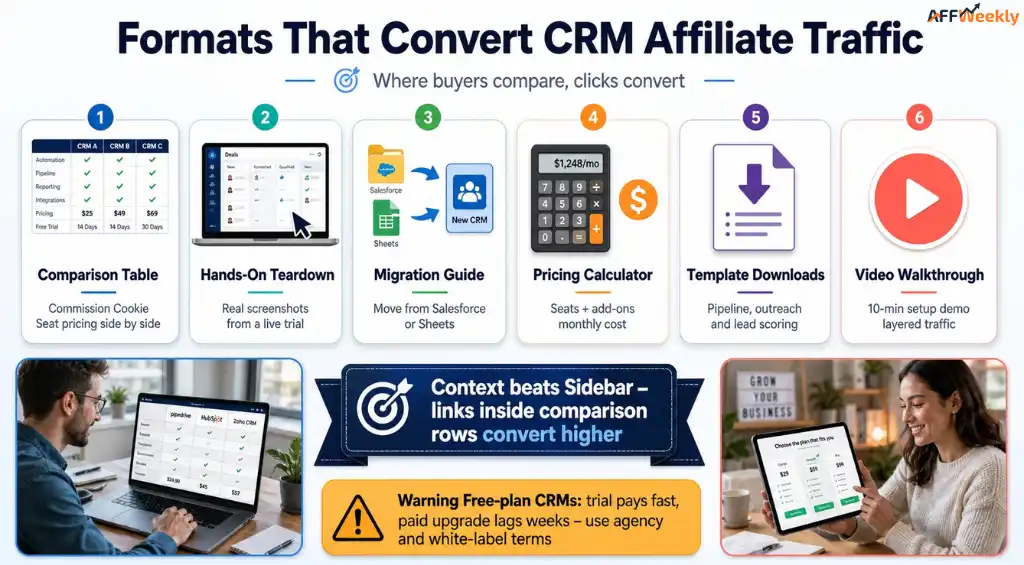
Formats that earn affiliate clicks:
Video walkthroughs add a second traffic layer. A ten-minute setup demo holds attention long enough for a description link to pick up trial signups.
Placement carries similar weight. Links sitting inside a comparison row or under a pricing table convert better than sidebar banners, because the reader is already weighing cost at that moment.
Free-plan CRMs deserve a caveat. Trials convert quickly, while paid upgrades land weeks later, pushing commissions into a following payout cycle.
Agencies handle that lag through different terms, which brings white label deals into the picture.
Final Thoughts
Commission rates get most of the attention, though they rarely decide what an affiliate actually earns. Attribution length, payout gates, and how long a referred account survives matter more over a full year.
The right fit depends on audience. Agency readers behave differently from freelancers, and a program built for one tends to underperform with the other.
Most affiliates land somewhere useful by promoting two or three CRM affiliate programs, then scaling whichever earns quietly in the background.
Give any program a couple of months before judging it. Recurring income reveals itself slowly.