
Top 7 Credit Card Affiliate Programs: Fees, Payouts & Rules
A single approved credit card application can pay more than a month of display ad income. Then the payout page loads, and the numbers stop making sense. One issuer pays per approval. Another pays per lead. A third pays nothing unless the cardholder spends within 90 days.
Credit card affiliate programs also sit inside strict finance rules. Some networks reject blogs with thin traffic. Others cap commissions by state or card type.
Marketers and beginner publishers often sign up first and read the terms later. The gap between advertised rates and actual earnings is where the money quietly disappears.
The Top Credit Card Affiliate Programs below are compared on the terms that decide what lands in the account.
What Credit Card Affiliate Programs Actually Pay You For
Payment in this niche is tied to a specific event, not to a click or a sale. Knowing which event triggers a commission tells you what to optimise for and how long the money takes to arrive.
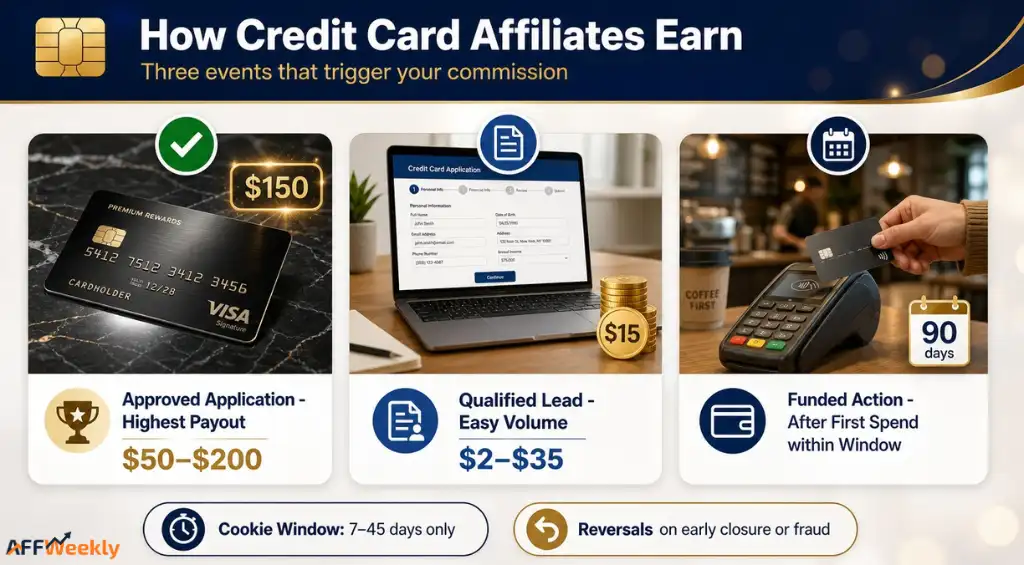
Three payout events cover most programs:
Two conditions sit on top of these events. Cookie windows are short, often 7 to 45 days, so attribution is lost faster than in retail affiliate marketing. Reversals also apply when an account closes early or an application is flagged as fraudulent.
Understanding the trigger explains why cookie length matters so much, which the next section breaks down.
Top 7 Credit Card Affiliate Programs
| Best Credit Card Affiliate Programs | Entry Barrier | Strongest Traffic Match |
|---|---|---|
| American Express | High, manual vetting | Premium travel reviews |
| Chase | High, invite-leaning | Rewards and business content |
| Capital One | Cardholder gate | Deals and savings audiences |
| Bankrate | Moderate, single application | Multi-card comparison pages |
| Credit Karma | Low, network approval | Credit score explainers |
| CommissionSoup | High, per-offer screening | Subprime and secured cards |
| Discover | Moderate, CJ approval | Student and cashback queries |
1. American Express Affiliate Program
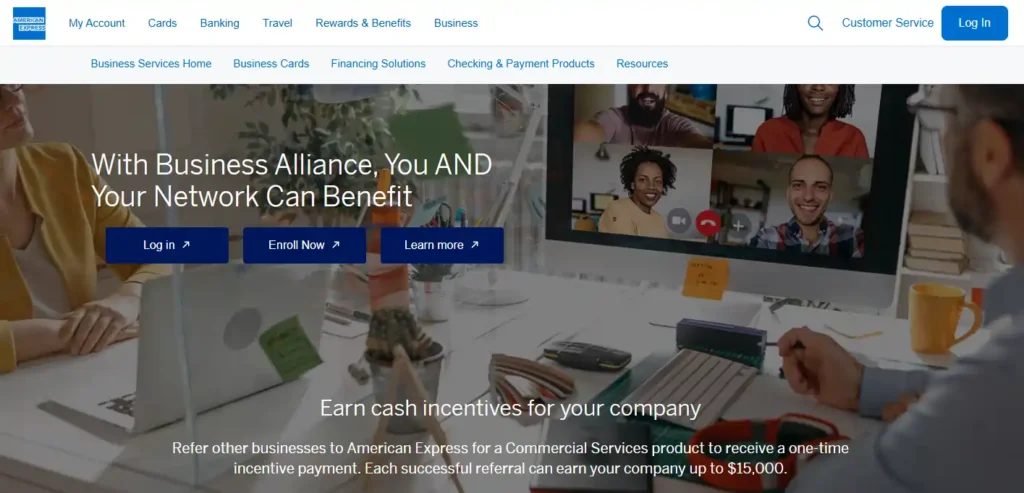
American Express runs one of the most recognised credit card affiliate programs in the US finance space, managed through CJ Affiliate in North America and through Daisycon for several European markets.
Payouts sit at the higher end of the category because Amex acquires cardholders with strong credit profiles. Affiliates are paid per approved application, not per click, so approval rate matters more than raw traffic volume.
The catch is attribution. Amex uses one of the shortest cookie windows among major issuers, which means comparison content and decision-stage pages convert far better than top-of-funnel guides for this credit card affiliate program.
Program Details
| Item | Detail |
|---|---|
| Network | CJ Affiliate (US, Canada), Daisycon (parts of EU) |
| Payout model | CPA on approved application |
| Reported US rate | Up to $200 per approved card |
| Cookie window | 7 days (US), 30 days (Daisycon) |
Who Should Use the American Express Program
Best for established personal finance and travel publishers with decision-stage traffic. The premium payout rewards sites that rank for specific card reviews rather than broad credit advice.
2. Chase Credit Card Affiliate Program
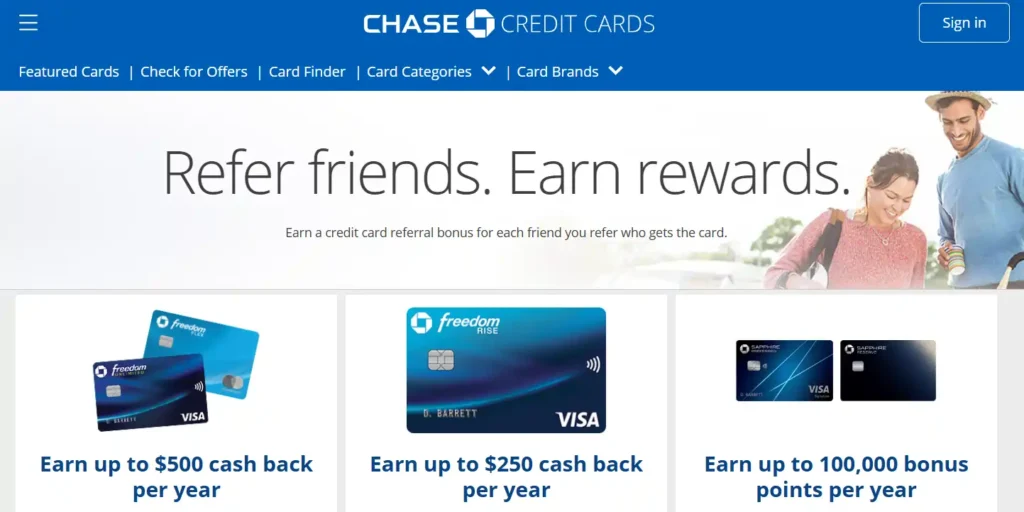
Publishers who want issuer-direct terms rather than network aggregation often start with Chase. The bank runs its partner program in-house and pays commissions across a product line that reaches well past credit cards.
Commission rates shift by product. Credit cards, particularly the Sapphire and Ink Business ranges, carry higher payouts than checking or savings referrals, which suits travel rewards and small business content.
Worth separating from the affiliate side is Chase Refer a Friend, a cardholder-only bonus scheme that pays points, not cash commissions. The two are frequently confused in credit card affiliate marketing discussions.
Program Details
| Item | Detail |
|---|---|
| Program type | In-house issuer program |
| Payout model | Per approved application, rate varies by product |
| Cookie window | 7 days (reported) |
| Card lines | Sapphire, Freedom, Ink Business, co-branded travel cards |
Who Should Use the Chase Program
Suited to travel rewards writers and small business finance publishers. The multi-product line lets one approved account monetise card, banking, and business content from a single relationship.
3. Capital One Affiliate Program

Two distinct routes exist under the Capital One name, and mixing them up costs publishers money. The affiliate route pays on the Capital One Shopping browser extension, while the referral route pays cardholders for successful card referrals.
Extension installs pay a percentage-based commission with an annual ceiling per affiliate, making it a volume play rather than a high-ticket one. It converts well on savings and deal-focused content.
The cardholder referral path works differently. Access requires holding an eligible Capital One card in good standing, which rules out publishers who write about the brand without banking with it.
Program Details
| Item | Detail |
|---|---|
| Affiliate route | Capital One Shopping extension |
| Reported extension rate | Up to 8% per install, up to $500 per year |
| Cookie window | 30 days |
| Referral route | Cardholder-only, unique referral link issued after approval |
Who Should Use the Capital One Program
Fits deal, coupon, and savings publishers for extension installs. The referral side works only for creators who already hold an eligible Capital One card themselves.
4. Bankrate Affiliate Program
Rather than joining a dozen issuers one at a time, publishers can apply once to the Bankrate Credit Cards Network and pull offers from many major US banks through a single account. That aggregation is the main reason it appears in almost every roundup of credit card affiliate programs.
Bankrate operates its own tracking platform instead of sitting on CJ or Impact, and supplies rate tables, card search widgets, and data feeds that drop into a site with JavaScript.
The trade-off is margin. As a sub-affiliate, your effective payout is lower than an issuer-direct deal, and specific rates surface only inside the account.
Program Details
| Item | Detail |
|---|---|
| Model | Sub-affiliate network, CPA-based, proprietary platform |
| Reported revenue share | Up to 40% per sale, varies by bank partner |
| Cookie window | 45 days (reported) |
| Offer inventory | Reported at up to 300 card products |
Who Should Use the Bankrate Program
Good for publishers who want breadth without managing multiple issuer relationships. Widgets and data feeds make it practical for comparison sites that update card tables frequently.
5. Credit Karma Affiliate Program
Conversion friction is the deciding factor with Credit Karma. The product is free, users sign up without a credit pull or a purchase, and commission triggers on registration rather than card approval.
That produces small per-action payouts and a much higher conversion rate than issuer programs. For high-traffic credit repair, credit score, and budgeting content, volume compensates for the low unit price.
Access runs through third-party networks rather than a direct in-house portal, with CJ Affiliate and FlexOffers both listing the offer. Rates differ slightly between networks, so it pays to compare before committing traffic.
Program Details
| Item | Detail |
|---|---|
| Payout model | CPL on new signup |
| Reported rate | $2.00 per new signup |
| Cookie window | 30 days |
| Networks | CJ Affiliate, FlexOffers |
Who Should Use the Credit Karma Program
Built for high-volume credit education sites and beginner finance channels. Low payout per lead, but the free signup removes the approval barrier that blocks issuer commissions.
6. CommissionSoup Affiliate Program
Operating since 2000 under Bulldog Media Group, CommissionSoup is a specialist CPA network built almost entirely around US financial offers rather than a general marketplace that happens to carry cards.
Rates are negotiated per offer rather than published, and application screening happens at both network level and individual offer level. Publishers who clear that gate often report payouts above what generalist networks advertise for the same card.
Inventory covers issuer offers and credit-building products, including secured cards aimed at applicants with thin or damaged credit files.
Program Details
| Item | Detail |
|---|---|
| Payout model | CPA and CPL, single tier, rate set per offer |
| Minimum payout | $35, paid monthly by check |
| Approval | Required separately for each offer |
| Offer examples | OpenSky Secured Visa, Credit One, Amex, Visa and Mastercard offers |
Who Should Use the CommissionSoup Program
Right for experienced US finance publishers with proven traffic. Per-offer approval and negotiated CPAs reward affiliates who can demonstrate application quality, not just click volume.
7. Discover Affiliate Program
Discover offers a direct relationship with a major US issuer through CJ Affiliate, and its no-annual-fee positioning makes the cards straightforward to recommend to first-time and student applicants.
Commission is paid on approved accounts, with consumer cards and student cards carrying different rates. Published figures vary noticeably across affiliate directories, so confirm current terms inside the CJ dashboard before modelling revenue.
Beyond cards, the affiliate account covers savings accounts, personal loans, student loans, and home equity products, giving broader finance sites more than one offer to work with.
Program Details
| Item | Detail |
|---|---|
| Network | CJ Affiliate |
| Payout model | CPA on approved account |
| Cookie window | 30 days (most widely reported) |
| Rate structure | Separate rates for consumer and student card accounts |
Who Should Use the Discover Program
Works well for student finance, credit-building, and cashback content. The no-annual-fee line converts with cautious first-time applicants who reject premium cards on cost.
Approval Requirements Shared by Most Credit Card Affiliate Programs
Getting accepted is harder than in almost any other affiliate vertical. Issuers screen partners before granting access because credit card content sits under financial advertising rules, and a weak partner creates legal exposure for the brand.
Most applications are judged on the same four checks:
Geography adds another filter. US programs restrict certain offers by state, and issuers rarely accept partners whose audience sits outside their licensed markets.
Once approved, the next problem is holding on to the commissions you earn.
How to Track Affiliate Commissions Properly
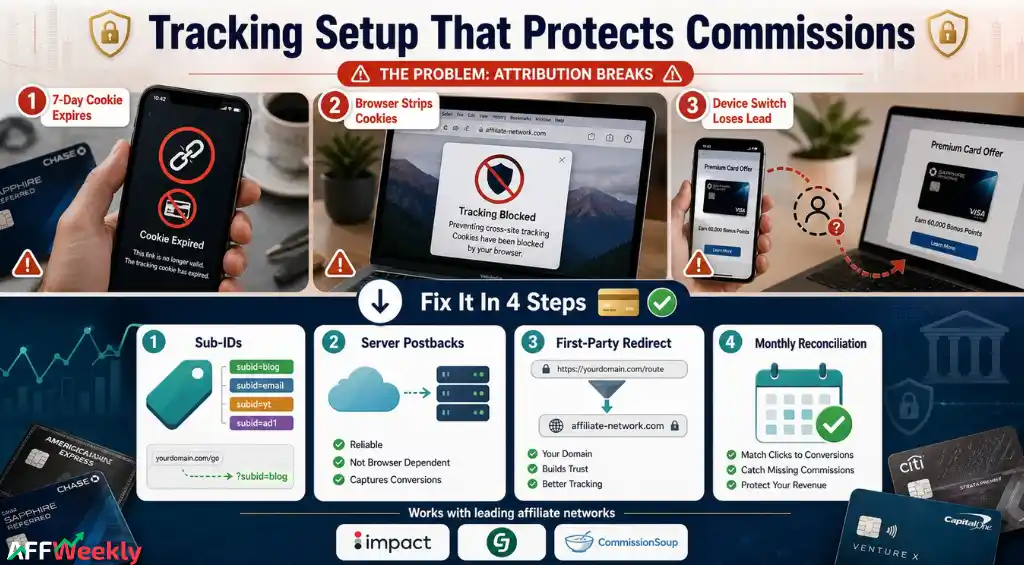
Approval gets you links. Tracking decides how much of that traffic you actually get paid for. Short cookie windows and multi-step applications mean conversions go missing more often here than in retail affiliate work.
Attribution breaks in predictable places. A 7-day cookie expires while the applicant compares cards. Safari and Firefox strip third-party cookies. Applicants also switch from mobile to desktop mid-application, and the referral is lost with the device.
A basic setup that reduces those losses:
Accurate data also feeds the revenue calculations covered next.
Final Take on Payout Terms and Program Fit
Payout size is the easiest number to compare and the least useful one on its own. What decides real earnings is approval rate, cookie length, and how long a commission stays on the books before it clears or reverses.
Start with one program that matches your existing traffic. Track it for a full validation cycle, then read the reversal data before adding another. Credit card affiliate programs reward patience more than volume.
Most publishers who do well here spent their first year learning the terms, not chasing the highest rate on the page.