
Top 9 Ezoic Alternatives for 2026 (Ranked by Traffic Tier)
Ad revenue drops after a site joins Ezoic. Page speed slips. Support tickets sit unanswered for days. For a blogger earning a few hundred dollars a month, that gap between promised EPMV and actual payout stings.
The confusion starts next. Some networks demand 50,000 sessions. Others approve instantly but pay pennies. Reddit threads contradict each other. Publisher forums argue over RPM screenshots that may or may not be real.
Ezoic alternatives exist for nearly every traffic level — new blogs, mid-size sites, and established media brands. The 9 top Ezoic alternatives covered below are sorted by approval requirements, payout terms, and ad quality, so the right fit depends on where a site sits today.
The 250K Threshold Hike That Made Ezoic Alternatives Urgent in 2026
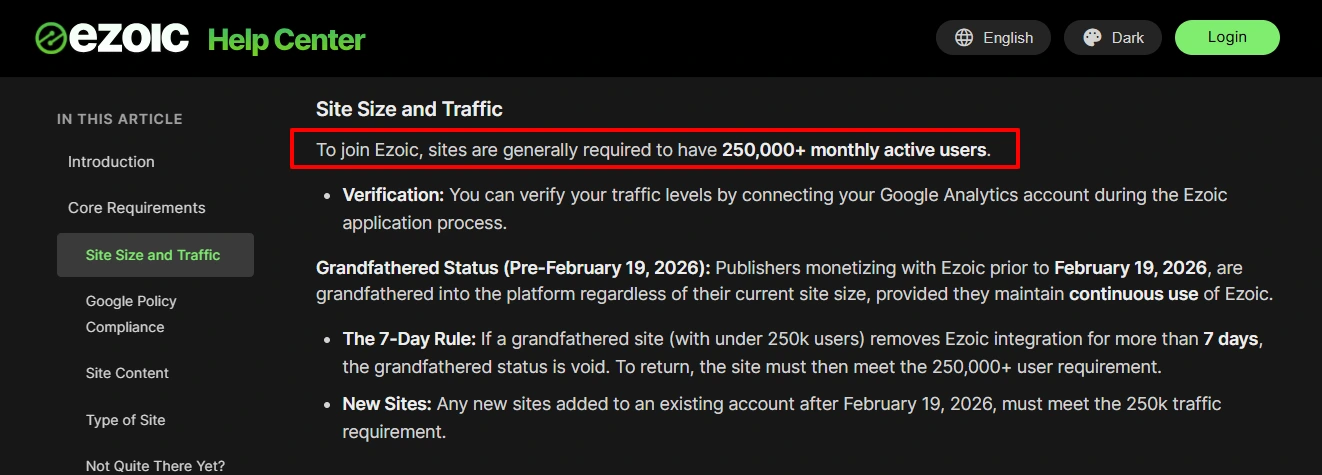
Ezoic changed who qualifies for its platform on 19 February 2026. The company raised its minimum audience requirement for new publishers from roughly 10,000 monthly users to 250,000 monthly active users — a twenty-five-fold jump announced from its Carlsbad, California headquarters.
The shift matters because eligibility now settles the question before any RPM comparison begins.
Ezoic's own support documentation confirms the current rules:
For a blog sitting at 20,000 or 80,000 monthly users, the arithmetic is plain: Ezoic has moved out of reach.
That single policy change pushed thousands of small publishers back into the market — which is where the scoring framework below earns its place.
How We Scored Each Network: A 5-Point Technical Framework
Most comparison guides rank ad networks by headline revenue share. That single number hides more than it reveals, because a 75% cut of a weak auction pays less than a 70% cut of a competitive one.
Each of the nine Ezoic alternatives below was scored against five technical criteria instead:
Scores across these five points determine the tier placement used throughout the rankings below.
9 Top Ezoic Alternatives, Ranked by Traffic Tier
| Top Ezoic Alternatives | Approval Style | Publisher Control |
|---|---|---|
| Newor Media | Application based | Low, team managed |
| Mediavine | Revenue verified | Low, preset layouts |
| Raptive | Strict quality review | Minimal, algorithm led |
| Setupad | Policy based screening | High, self-serve tier |
| MonetizeMore | Consultative onboarding | Moderate, full visibility |
| Monumetric | Manual, multi-week | Low, credentials shared |
| Media.net | Manual editorial review | Moderate, styling options |
| Adsterra | Near-instant automated | High, per-zone control |
| Google AdSense | Policy compliance check | High, placement choice |
1. Newor Media
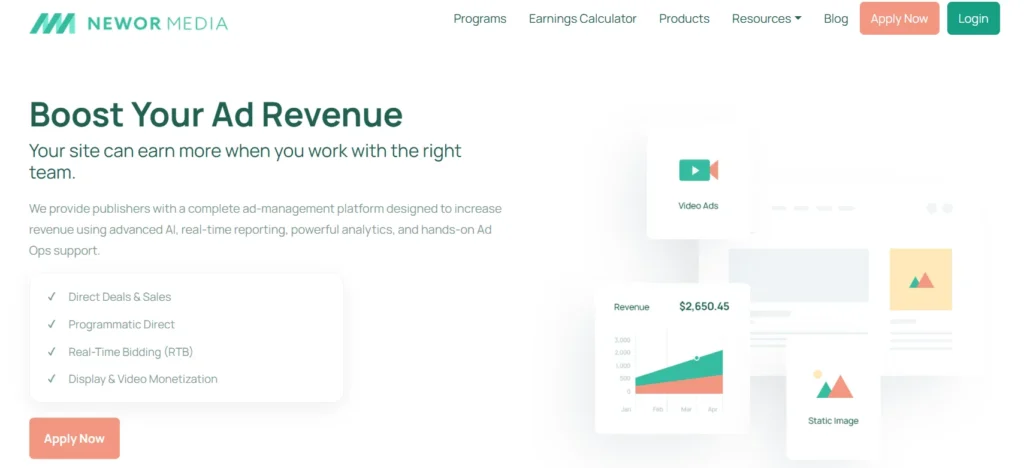
Newor Media built its business around a gap that opened when premium networks raised their bars: quality small publishers with nowhere credible to go. The company positions itself as an accessible Ezoic alternative and route into real programmatic monetisation rather than a remnant-fill option.
The operational difference shows in the auction. Inventory is exposed to several premium buyers at once, creating bidding pressure on each impression instead of accepting whatever a single exchange returns. Floor prices and bidder selection get tuned per site.
Publishers share analytics during onboarding and the ad ops team takes configuration from there. Expect yield to fluctuate for the first few weeks while demand algorithms learn the inventory, a normal pattern across managed partners rather than a warning sign.
| Attribute | Detail |
|---|---|
| Entry threshold | 5,000 monthly users |
| Integration style | Fully managed |
| Auction model | Multi-partner header bidding |
| Payment terms | Net-30 |
| Niche coverage | Broad vertical acceptance |
| Technical skill needed | Minimal |
Why Choose Newor Media: Best for small publishers pushed out by the 250K rule. Suits bloggers wanting genuine header bidding without ad ops skills or a lifestyle-only niche.
2. Mediavine

Mediavine spent a decade defined by a fixed session bar, then abandoned it at the start of 2026. Eligibility for the main network now turns on earnings, on the reasoning that revenue proves an audience advertisers genuinely value, where visit counts can be inflated by low-quality or AI-driven traffic.
The company runs a two-stage ladder. Smaller publishers enter through a self-supported on-ramp programme with lighter service, then upgrade automatically once earnings clear the main-network bar. Promotions are one-way: sites moved up stay up even if traffic later declines.
Publishers who joined before the change may retain their original terms and loyalty bonuses, a detail worth confirming before any migration decision.
| Attribute | Detail |
|---|---|
| Main network entry | $5,000 annual revenue |
| Journey entry | 1,000 monthly sessions |
| Journey revenue share | 70% |
| Required plugin | Grow by Mediavine |
| Payment terms | Net-65 |
| Strongest verticals | Food, parenting, home |
Why Choose Mediavine: Ideal for lifestyle and food bloggers with Tier 1 traffic. Journey lets very small sites start early, while the main network delivers premium RPMs once revenue qualifies.
3. Raptive

Raptive carries the lineage of AdThrive and CafeMedia, and with it a reputation as the most selective managed Ezoic alternative serving independent creators. In late 2025 the company cut its traffic bar sharply and retired its separate small-site programme, consolidating everyone into one entry level.
Approval leans far more on where readers come from than how many arrive. Two geography bands apply, with the stricter ratio falling on smaller sites, which excludes publishers whose audience sits outside core English-speaking markets regardless of volume.
Accepted creators receive layout design, direct-sold demand access, and a named account contact. The trade-off is control, since placement and density decisions largely sit with Raptive, and cancellation requires advance notice.
| Attribute | Detail |
|---|---|
| Entry threshold | 25,000 monthly pageviews |
| Tier 1 rule (under 100K) | 50% minimum |
| Tier 1 rule (above 100K) | 40% minimum |
| Entry tier name | Insider |
| Service model | Fully managed |
| Domain age rule | Six months |
Why Choose Raptive: Suits established Tier 1 creators wanting white-glove management. Strongest for food, lifestyle, and finance sites that clear the quality review and geography requirements.
4. Setupad
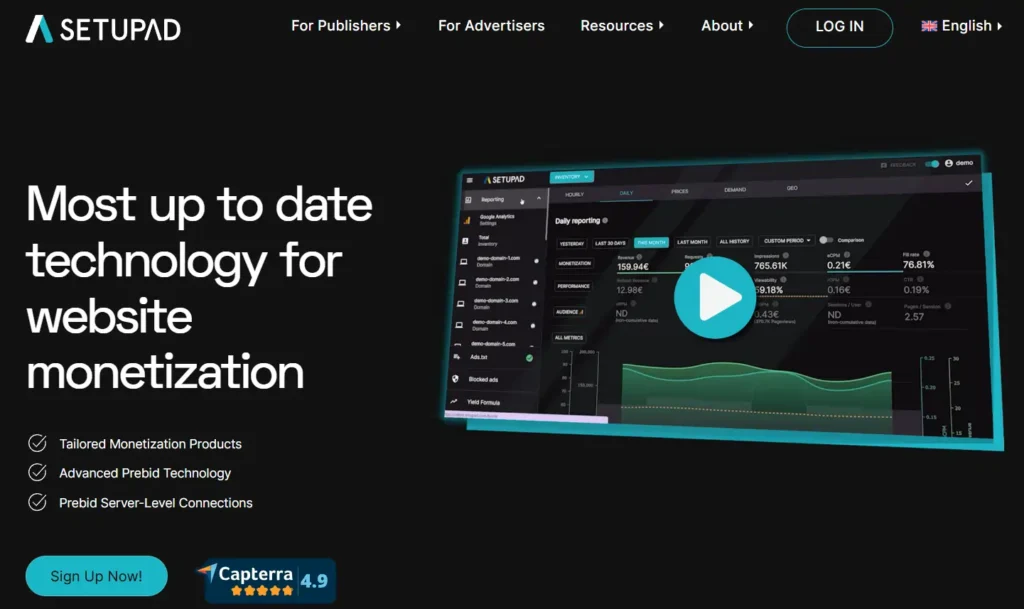
Setupad sells engineering rather than account management. Its core product lets a single publisher tap a bank of international supply-side platforms that would otherwise demand impression volumes far beyond one site's reach.
Commercial terms are negotiated case by case instead of fixed. The platform's cut is capped at roughly a fifth of revenue and can fall considerably lower, and a separate fixed-fee arrangement exists for publishers who prefer predictable costs over a percentage split.
European demand is where the company holds a real edge, with exchange relationships and privacy tooling that US-centric platforms often treat as an afterthought. Applications are assessed against a published quality policy, so approval stays discretionary rather than purely numerical.
| Attribute | Detail |
|---|---|
| Technology base | Prebid.js wrapper |
| Headquarters | Riga, Latvia |
| Service tiers | Managed, self-serve |
| Inventory support | Web, AMP, in-app |
| Compliance strength | GDPR consent management |
| Commonly cited entry | 100,000 monthly visitors |
Why Choose Setupad: Best for technically confident publishers and European sites needing GDPR-ready header bidding. Self-serve control appeals to teams already running Google Ad Manager.
5. MonetizeMore
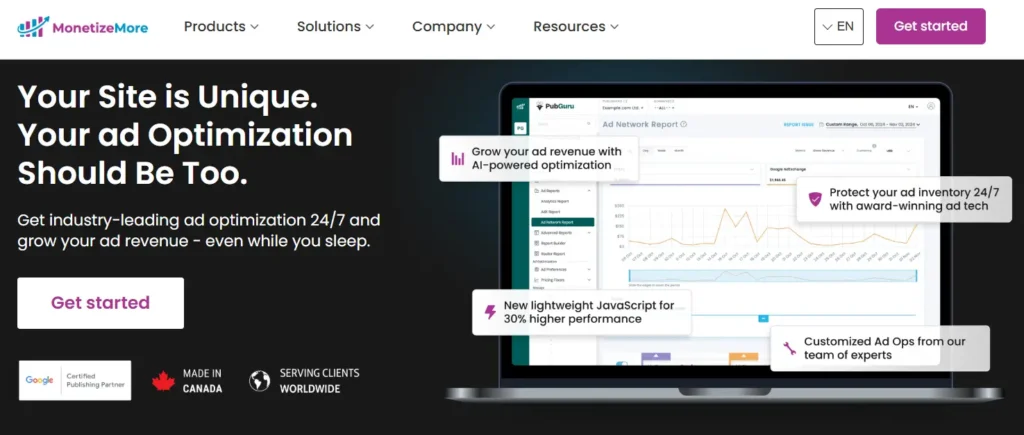
MonetizeMore answers a problem that arrives with scale: a large site's ad stack eventually needs a specialist team, and hiring one internally rarely makes financial sense. The company absorbs that function, taking over bidder management, floor optimisation, and layout testing.
Fraud and invalid traffic control sit unusually high in the offering. Filtering non-human impressions protects a publisher's standing with buyers, which matters more at volume because a poor traffic-quality signal can suppress bids across an entire account.
Engagements typically run a minimum optimisation window rather than month to month, since auction data needs time to mature. That structure, paired with a higher entry bar, makes this a scaling partner rather than a first network.
| Attribute | Detail |
|---|---|
| Company status | Certified Publishing Partner |
| Core dashboard | PubGuru platform |
| Diagnostic tool | Ad Inspector extension |
| Auction approach | Managed header bidding |
| Exchange access | Google AdX |
| Pricing model | Revenue share |
Why Choose MonetizeMore: Fits larger publishers wanting outsourced ad operations and AdX access. Best where reporting depth and invalid traffic control matter more than a low entry threshold.
6. Monumetric

Monumetric structures its whole offering around growth stages, moving publishers up through progressively deeper service as traffic climbs. The practical effect is that a small blog and a large media site work with the same company under very different arrangements.
Onboarding is genuinely hands-off. Publishers supply admin credentials and the team installs and positions units itself, a workflow suited to people who would rather write than configure placements. Manual review plus implementation usually spans a few weeks end to end.
Niche acceptance runs broader than most premium networks, with tech, personal finance, and hobby sites well represented. The catch is a set of layout prerequisites that some themes fail outright, so compatibility is worth checking before applying.
| Attribute | Detail |
|---|---|
| Entry programme | Propel tier |
| Propel range | 10K to 80K pageviews |
| Setup fee | $99 one-time |
| Payment terms | Net-60 |
| Sidebar requirement | 300 pixels minimum |
| Ad slot requirement | Six slots |
Why Choose Monumetric: Solid middle step for blogs above 10,000 pageviews that miss premium thresholds. Worth it where hands-off ad placement outweighs the upfront setup cost.
7. Media.net
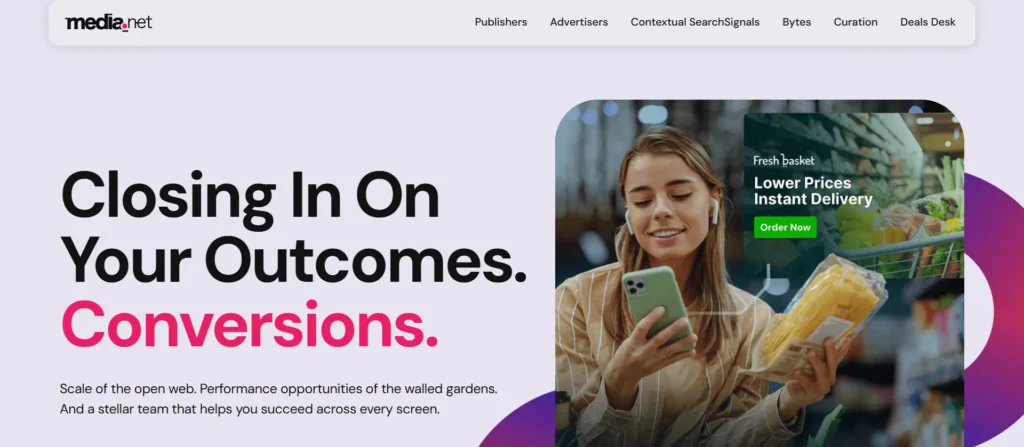
Media.net matters strategically for a reason that has little to do with headline earnings: it is one of very few Ezoic alternative demand pools sitting outside Google's ecosystem. Publishers routing everything through a single supply chain carry concentration risk, and one policy action can zero out revenue overnight.
The units themselves read closer to search listings than display creative, which changes how readers respond to them. Pages built around clear commercial subjects give the matching engine more to work with, so yield differs sharply between a tightly focused article and a broad lifestyle post.
Performance narrows heavily by reader location, making it a weak primary choice for globally distributed audiences.
| Attribute | Detail |
|---|---|
| Demand source | Yahoo Bing network |
| Targeting method | Contextual matching |
| Best traffic origin | United States, UK |
| Payment terms | Net-30 |
| Customisation | Colour, layout control |
| Approval process | Manual review |
Why Choose Media.net: Suits content-heavy finance, business, and tech sites with US or UK readers. Useful as a non-Google demand layer beside a primary network.
8. Adsterra
Adsterra sits at the opposite end of the market from the managed partners above. Where they filter applicants on audience quality, Adsterra monetises inventory that premium buyers simply ignore, and treats breadth of format as the mechanism for doing it.
That design favours particular site types. Streaming, downloads, utilities, and entertainment properties tend to perform well, while informational content in competitive niches usually earns more through display-led partners.
The honest trade-off is reader experience. Higher-yield units interrupt more than standard banners, so many publishers deploy them selectively on secondary pages while keeping core articles clean. Parallel use with other platforms is permitted, which makes it workable as a supplementary layer rather than a full replacement.
| Attribute | Detail |
|---|---|
| Traffic requirement | None |
| Signature formats | Popunder, Social Bar |
| Payout frequency | Bi-weekly |
| GEO strength | Tier 2, Tier 3 |
| Ad safety | In-house malware screening |
| Approval speed | Near instant |
Why Choose Adsterra: Best for new or globally distributed sites with no route into premium networks. Strong on non-Tier 1 traffic, though some formats read as intrusive.
9. Google AdSense

Google AdSense functions less as a rival to the networks above and more as the reference point they define themselves against. Almost every publisher begins here, and most yield comparisons in this space are framed as a multiple of what AdSense returns.
Acceptance rests on editorial standards instead of audience size. Thin content, missing policy pages, scraped material, and weak navigation account for the bulk of rejections, meaning the work required to pass is the same work that later qualifies a site for premium partners.
Its ceiling comes from architecture rather than effort. With no competing bidders, nothing exists to push the clearing price upward, so earnings scale with traffic alone.
| Attribute | Detail |
|---|---|
| Traffic requirement | None |
| Revenue share | 68% content ads |
| Payout threshold | $100 |
| Demand structure | Single source |
| Integration effort | One script |
| Ideal role | Baseline or fallback |
Why Choose Google AdSense: Right for brand-new sites with no other option, or as a fill layer. Reliable and simple, though RPM ceilings stay low without header bidding.
Leaving Ezoic Cleanly: The Technical Exit Checklist

Ezoic sits deeper in a site's infrastructure than a typical ad tag. Depending on setup, it may control nameservers, a Cloudflare app, a WordPress plugin, and AdSense account permissions. Missing a layer causes downtime, duplicate ad calls, or suppressed CPMs on the incoming network.
Work through the layers in order:
Which Ezoic Alternative Fits Your Site?
The threshold change forced a decision most publishers were putting off. That turns out to be useful, because a single network rarely stays right forever.
Two things matter more than any ranking above: your actual traffic level, and where your readers live. Those two facts narrow nine Ezoic alternatives down to two or three realistic applications.
Run a parallel test for thirty days before committing. Watch RPM, page speed, and how ads sit within your layout.
Ad revenue rewards patience far more than it rewards speed.