
8 Best Impact Alternatives Built for Real Partner Programs

Affiliate programs rarely stall because of bad offers. They stall because the platform behind them feels heavier than the work itself. Teams sign up with Impact, then spend weeks buried in setup calls, enterprise contracts, and dashboards built for someone else's workflow.
Then comes the harder question. Is the problem the tool, the pricing tier, or a mismatch in scale? Reviews rarely agree. One brand calls it essential. Another calls it overkill for a small partner network.
That gap is where the search for Impact alternatives usually begins. The 8 best Impact alternatives below approach partnerships very differently — some lighter, some cheaper, some built for creators rather than enterprise teams.
Why Brands Replace Impact.com: 6 Failure Points Behind the Switch
Understanding the reasons behind a platform switch clarifies whether Impact.com suits your program or whether a lighter alternative would serve better.
Most exits trace back to structural mismatches rather than missing features.
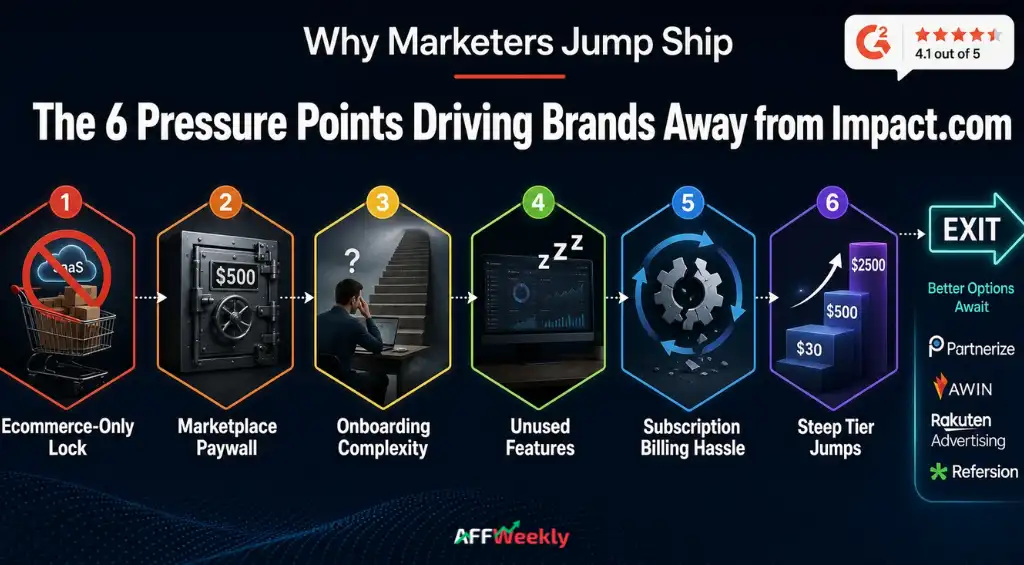
Six issues appear consistently across G2 reviews and published platform comparisons:
These pressure points rarely appear alone. Brands typically hit two or three at once, usually as a program matures past its launch phase.
Weighing them against your partner mix and program size narrows the field considerably. The eight platforms below resolve each pressure differently.
The 8 Best Impact Alternatives, Ranked by Partnership Model
| Best Impact Alternatives | Tracking Method | Cookieless Readiness |
|---|---|---|
| PartnerStack | First-party JavaScript | Server-side supported |
| FirstPromoter | Cookie plus API | Server-side available |
| Rewardful | Webhook-based attribution | Billing-event driven |
| Partnero | Cookie plus postback | Server-side option |
| Tapfiliate | JavaScript and postback | S2S fully supported |
| Awin | Network tracking domain | Awin server-side |
| Everflow | Server-to-server postback | Fully cookieless capable |
| Partnerize | Enterprise server-side | Cookieless by design |
1. PartnerStack
PartnerStack operates as a partner relationship management system rather than a straightforward affiliate tracker, which is why it heads most Impact alternatives shortlists for B2B software companies. The platform handles resellers, agencies, referral partners and affiliates inside one environment.
Programs run through deal registration, co-selling workflows and tiered partner groups, so a sales-led channel stays visible alongside self-serve affiliate revenue. Its attached B2B network gives recruitment reach that standalone tracking tools cannot replicate.
One trade-off deserves attention: access runs through a demo conversation rather than self-serve signup, recreating part of the friction brands leave Impact.com to escape. Later-stage software companies with a dedicated partnerships function get the most from it.
| Attribute | Detail |
|---|---|
| Platform category | Partner Relationship Management (PRM) |
| G2 rating | 4.7 out of 5 across 921 reviews |
| Plan structure | Launch, Growth and Enterprise tiers |
| Access model | Demo-led onboarding |
PartnerStack Key capabilities
Why choose PartnerStack: Built for software companies whose partners sell rather than refer. Strongest when reseller and agency channels need managing alongside a conventional affiliate program.
2. FirstPromoter
Purpose-built for subscription businesses, FirstPromoter narrows its scope deliberately. Instead of covering influencer campaigns and brand partnerships, it concentrates on affiliate programs tied to recurring revenue, making it a practical Impact.com alternative for SaaS teams launching a first program.
Setup connects to subscription billing and applies sensible defaults for recurring commissions, so plan upgrades, downgrades and refunds flow through without custom configuration. Fraud tooling sits on the platform rather than behind an upgrade.
Its ceiling is recruitment. No partner network sits behind the software, so once a team has invited its existing contacts and users, reach stops expanding. Teams that already know who their affiliates will be rarely notice this constraint early.
| Attribute | Detail |
|---|---|
| Built for | Subscription and SaaS revenue models |
| Billing integration | Native Stripe support |
| Fraud tooling | Included across plans |
| Partner network | None attached |
FirstPromoter Notable features
Why choose FirstPromoter: Suits SaaS companies starting a first affiliate program with a known partner list. Support reputation and reliable recurring tracking are its clearest advantages.
3. Rewardful
Speed defines Rewardful's position among Impact alternatives. Where enterprise partnership platforms measure implementation in weeks, this one connects to Stripe or Paddle, applies a commission structure and accepts affiliate invitations inside a single working session.
That compression comes from narrow focus. The platform reads subscription billing events directly, so attribution, recurring payouts and refund handling inherit logic from the payment processor rather than requiring separate rules.
Its Affiliate Finder attempts partner discovery across the open web, which is uncommon at this level of the market. Discovery on the open web still differs from a curated network, though, and teams typically migrate once recruitment rather than tracking becomes the bottleneck.
| Attribute | Detail |
|---|---|
| Billing processors | Stripe and Paddle |
| Payout rails | PayPal and Wise |
| Fraud checks | Self-referral detection on all plans |
| Setup time | Same-day activation |
Rewardful Practical strengths
Why choose Rewardful: Ideal for subscription businesses billing through Stripe or Paddle that want a working program immediately. Best while an existing audience supplies affiliates.
4. Partnero

Two program types run inside Partnero at once, affiliate and referral, which separates it from tools covering only one. Companies wanting customer referrals alongside a publisher affiliate channel avoid maintaining two subscriptions and two sets of partner data.
Setup stays deliberately light. Onboarding, commission configuration and payout automation are designed for teams without a dedicated partnerships hire, and integrations cover common SaaS tooling.
Unlimited partners and unlimited transactions across plan levels is genuinely unusual in this category, since most competitors cap affiliate headcount or click volume. The entry level supports a single program, so pairing affiliate and referral together requires moving up a tier.
| Attribute | Detail |
|---|---|
| Program types | Affiliate and referral in one platform |
| Partner limits | Unlimited across plans |
| Transaction limits | Unlimited across plans |
| Trial period | 30 days |
Partnero Core functionality
Why choose Partnero: A sensible pick for small teams running affiliate and referral motions together. Simplicity and uncapped partner counts outweigh its narrower feature depth.
5. Tapfiliate
Branding control is Tapfiliate's distinguishing trait among Impact.com alternatives. Affiliate-facing dashboards carry the merchant's identity rather than the vendor's, which matters when partners interact with the interface as an extension of the brand.
The platform has operated long enough to accumulate broad integration coverage, spanning Shopify and WordPress alongside SaaS billing systems. Mixed business models sit comfortably on it, covering ecommerce stores, subscription services and B2B or B2C brands within one account.
Volume caps on entry tiers merit modelling before commitment. Clicks, conversions and affiliate counts carry defined ceilings, with overage fees beyond them, so content-driven programs generating heavy traffic should project click volume in advance.
| Attribute | Detail |
|---|---|
| Branding | White-label affiliate dashboards |
| Business models | Ecommerce, SaaS, subscription, B2B and B2C |
| Ecommerce integrations | Shopify and WordPress |
| Plan constraints | Click and conversion volume caps |
Tapfiliate Feature highlights
Why choose Tapfiliate: Best for brands running mixed portfolios or where affiliate-facing presentation matters. A strong generalist rather than a specialist in any single model.
6. Awin
Network scale rather than software depth explains Awin's presence on this list. Many brands evaluating Impact.com actually need publisher recruitment, and Awin operates one of the largest affiliate marketplaces available, with more than one million publishers across Awin and its sister network ShareASale.
Those two networks remain administratively separate. Reaching the full publisher base means registering with each independently and vetting partners across both, which adds operational work compared with a single curated marketplace.
Sector strength concentrates in retail, fashion, travel, finance and ecommerce, including experience with brick-and-mortar brands. Educational resources for partners are well developed, which shortens the ramp for programs recruiting less experienced publishers.
| Attribute | Detail |
|---|---|
| Network size | Over one million publishers with ShareASale |
| Network structure | Awin and ShareASale operate separately |
| Sector strength | Retail, fashion, travel, finance, ecommerce |
| G2 rating | Approximately 4.1 out of 5 |
Awin Network advantages
Why choose Awin: Right for retail, travel and ecommerce brands where recruitment reach outranks platform sophistication. Expect more partner vetting than a curated network requires.
7. Everflow

Tracking architecture sits at the centre of Everflow, placing it in the same technical weight class as Impact.com's measurement layer. Performance marketing teams select it for attribution granularity rather than for partner relationship features.
Coverage extends across affiliate, referral, influencer and direct advertising partnerships, with analytics exposing traffic sources, placement performance and conversion paths at a level most SaaS-focused trackers keep hidden. Multi-currency payouts and global payment rails support programs operating across regions.
Quote-based commercial terms mean budgeting requires a sales conversation, which is the same friction pushing some teams away from Impact.com in the first place. Choosing Everflow makes sense on capability grounds rather than as an escape from enterprise sales processes.
| Attribute | Detail |
|---|---|
| Platform category | Performance marketing and partner tracking |
| Partnership coverage | Affiliate, referral, influencer, direct advertising |
| Payout support | Multi-currency and global payment rails |
| Commercial model | Quote-based |
Everflow Technical capabilities
Why choose Everflow: Suited to programs expanding internationally where payout infrastructure and tracking depth are the genuine constraints, not partner discovery or ease of setup.
8. Partnerize

Among Impact alternatives aimed at large organisations, Partnerize competes directly on enterprise partnership infrastructure. The platform serves brands running mature programs across several markets simultaneously, where coordination rather than launch speed is the operational challenge.
Automation carries much of the workload. Campaign management, partner optimisation and performance visibility operate across international ecosystems, with reporting segmented by region so local teams work from data relevant to their markets.
Brands already trading across multiple territories commonly evaluate Partnerize and Impact.com side by side, since both target comparable organisational scale. The decision usually turns on which platform's automation model fits existing internal workflows more closely.
| Attribute | Detail |
|---|---|
| Target organisation | Enterprise and multi-market brands |
| Programme focus | Global partnership management |
| Reporting structure | Multi-region segmentation |
| Commercial model | Custom |
Partnerize Enterprise capabilities
Why choose Partnerize: Appropriate for enterprise brands managing partnerships across multiple countries. Chosen for automation and international reach, not for lower cost or simpler setup.
Migrating Off Impact.com: A 5-Step Switch Without Losing Affiliate Links
Affiliate links carry accumulated SEO value and sit inside published reviews, comparison posts and newsletters you have zero control over. Breaking them mid-migration costs revenue that rarely returns. A sequenced switch protects both tracking continuity and partner trust.
Five steps keep the transition clean:
Several vendors, including Reditus, handle migration directly at no charge. Ask before committing.
When Impact.com Still Beats Every Alternative on This List
Switching platforms makes sense only when the mismatch is structural. Plenty of programs run better on Impact.com than on anything cheaper, and leaving would mean rebuilding capability you already paid to develop.
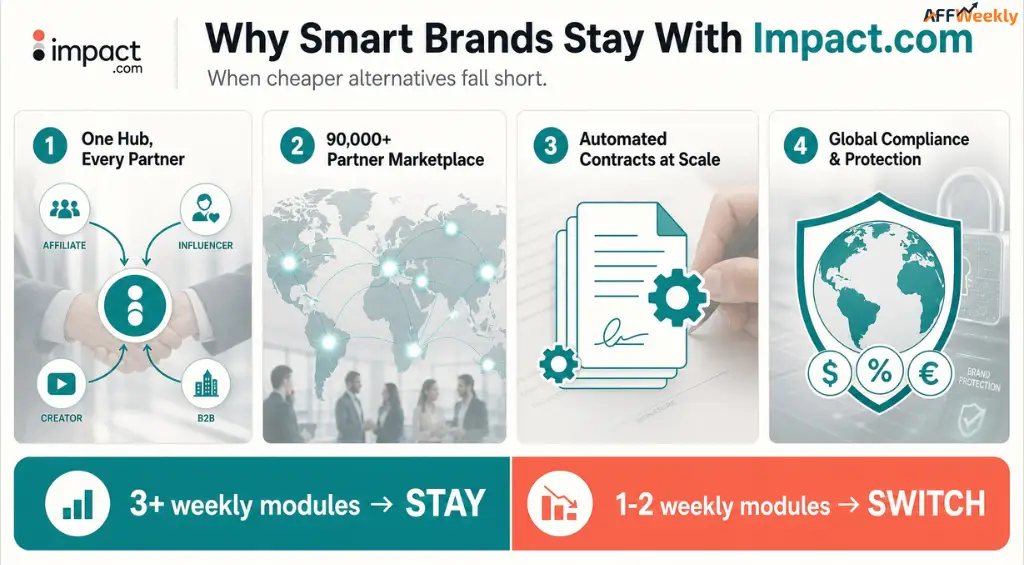
Four scenarios favour staying put:
A useful test: list the Impact.com modules your team opens weekly. Heavy usage across three or more signals the platform earns its price. Light usage of one or two points toward a specialised replacement.
The comparison table below maps each alternative against these capabilities.
Final Verdict on Impact Alternatives
Platform decisions rarely come down to feature counts. What matters more is the shape of your partner mix, the stage your program sits at, and how much internal time you can realistically give it.
Most teams comparing Impact alternatives already sense which direction fits. The research usually confirms an instinct rather than reversing it.
Run a short trial before committing. Two weeks with real partner data reveals far more than any comparison table.
Programs grow into their tooling. Start with what your team can actually manage today.